Key Takeaways
Explains why traditional antivirus solutions are no longer sufficient against modern malware.
Discusses how Fidelis Endpoint uses behavioral threat detection to identify advanced attacks that evade signature-based detection.
Explores the role of continuous endpoint telemetry in detecting ransomware, fileless malware, and living-off-the-land (LotL) attacks.
Highlights on how real-time monitoring and automated response help reduce attacker dwell time and contain malware before it spreads.
Covers Fidelis Endpoint’s forensic investigation capabilities for faster root-cause analysis and incident response.
Examines how threat intelligence and contextual analysis improve detection accuracy while reducing false positives.
Enterprise malware has been a whole new ballgame over the last ten years. The days of traditional viruses and malicious executable files are gone as cybercriminals try to use other techniques to break into systems. Rather, they rely on ransomware, fileless threats, living-off-the-land (LotL) attacks, zero-day attacks, malicious scripts, and stolen credentials to beat the traditional security drills. These attacks often take advantage of legitimate system tools and trusted applications and are much harder to detect using signature-based antivirus solutions.
Meanwhile, organizations have increased the number of spaces they occupy online via cloud adoption, hybrid work, and remote access. Employees are using business-critical applications from various locations and using various devices, which adds more endpoints to secure the security team. With each laptop, desktop or workstation being a potential attack vector, endpoint security is now a key part of enterprise cyber resilience.
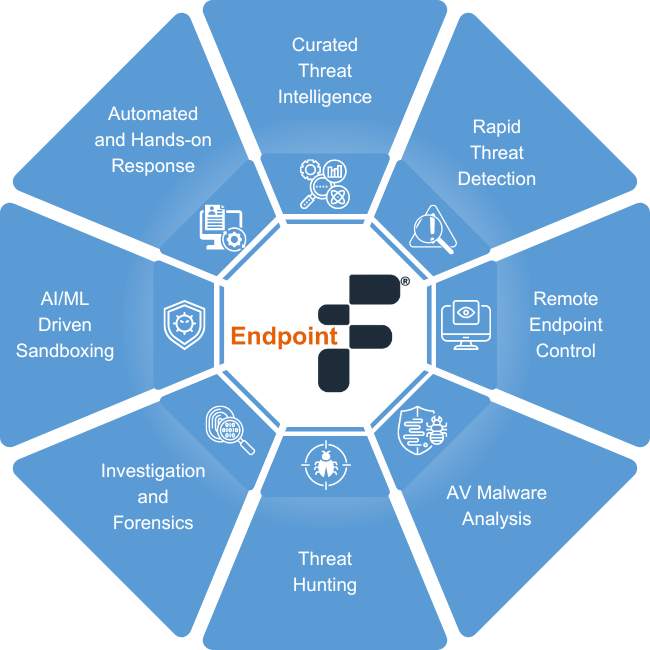
Even if the attack is not malicious and doesn’t change its behavior, traditional AVs are not meant to detect it because it has no malicious files. Today’s business demands endpoint protection that offers real-time visibility, detects suspicious activity, and can quickly respond to prevent malware spreading through the environment. Fidelis Endpoint® is designed to solve these problems by integrating Endpoint Detection and Response (EDR), behavioral analytics, continuous endpoint telemetry, automated response, and deep forensic analysis and investigation into a single platform. Fidelis Endpoint® doesn’t just rely on known malware signatures; it analyzes endpoint behavior to identify advanced threats at any stage in the attack lifecycle, enabling organizations to investigate incidents quickly and increase enterprise malware protection.
How Fidelis Endpoint Strengthens Enterprise Malware Protection
1. Detects Advanced Malware Through Behavioral Threat Detection
One of the biggest challenges in protecting enterprise endpoints is the increasing use of malware that avoids traditional detection methods. Today’s attackers are also able to modify the behavior of malware, execute scripts directly from memory, or leverage legitimate tools, such as PowerShell, Windows Management Instrumentation (WMI) and command line tools. The files do not have to be malicious, and signature-based virus and spyware protection won’t necessarily catch them when using these tools.
Fidelis Endpoint® uses endpoint behavior to detect suspicious activities that could be a part of an attack; not just malware signatures. The platform assesses the interactions between processes, the behavior of applications, as well as checks for known attacks to determine if endpoint activities resemble malicious behavior. For instance, running PowerShell on its own is a standard admin task, and not a red flag. If Microsoft Word opens PowerShell and downloads content from a remote location, sets up persistence, writes registry keys, and makes outbound connections, the series of events is a pretty sure sign of an attack. Advanced malware is detected even if there is not a known malware signature, by correlating these behaviors with Fidelis Endpoint®.
What data has been potentially exposed?
Incursion detection and Persistence detection
How should I respond?
2. Provides Continuous Visibility Across Endpoint Activity
To provide effective protection against malware, it’s important to know what’s going on with all the enterprise’s endpoints. Single alerts do not capture enough information to establish if suspicious activity is a real attack or an innocuous administrative activity. In low-visibility environments, security teams may not be able to be alerted to compromise in time or lose valuable time attempting to piece together the evidence across multiple tools. Fidelis Endpoint® is continually monitoring endpoint telemetry and fully covers process, file activity, registry changes, user actions, system activity, network activity, and script activity. Rather than viewing these events individually, the platform correlates these events together in a single attack timeline, which enables analysts to gain insights into how the malware operates from the point of initial compromise to remediation.
This constant visibility allows analysts to determine how malware got into an endpoint, what it did, if it was able to survive and persist on the endpoint, and if it tried to move laterally across the environment. Security teams will have a fuller context of the attack sequence than just the individual incidents, and better be able to investigate and respond in time before the malware spreads widely.
3. Accelerates Malware Detection and Response
Many of the impacts of a security incident will depend on how quickly they can detect and respond to malware. When attackers can access an endpoint, they will usually try to elevate privileges, steal credentials, move laterally, and install other malicious software. Delayed detection provides attackers with more time and opportunities to continue to grow their access and to compromise more systems.
Fidelis Endpoint® mitigates this by constantly monitoring endpoint activity and detecting suspicious activity in real time. Security teams are alerted to take action as soon as the indicators of malicious activity appear and provide them with detailed contextual information to help them start investigating the activity. Detecting malware is only part of an effective endpoint security strategy. Organizations must also contain threats before they disrupt business operations. Fidelis Endpoint® enables analysts to isolate compromised endpoints, terminate malicious processes, quarantine suspicious files, and collect forensic evidence remotely. These capabilities help reduce attacker dwell time and limit malware spread across the enterprise.
4. Simplifies Malware Investigations with Deep Endpoint Forensics
Investigating malware requires more than identifying an infected endpoint. Security teams must understand how attackers gained access, what actions of malware performed, which systems were affected, and whether additional endpoints remain compromised. Fidelis Endpoint® provides comprehensive forensic visibility that enables analysts to reconstruct attacks from initial compromise through final execution.
Analysts can rapidly view the parent and child processes of an attack, see which files are created or modified, analyze suspicious registry changes, and see network connections that malware made to the outside world, instead of manually gathering evidence from several endpoint security tools. Such a forensic visibility enables quick incident response and enables root cause analysis to be conducted. Knowing what type of attack has taken place helps organizations improve their security measures, plug out any exposed vulnerabilities, and lessen the risk of future attacks.
5. Improves Detection Accuracy Through Context and Threat Intelligence
Alert fatigue is one of the biggest problems faced by security operations centers (SOC). While traditional endpoint security solutions generate thousands of alerts because of isolated events, many of these alerts are benign. It takes a lot of time for analysts to investigate false positives and not be able to concentrate on real threats. By putting events in larger context, Fidelis Endpoint® enhances detection accuracy. The platform looks for the relationship between multiple endpoint activities and whether the combination of activities is like known attack patterns, instead of issuing alerts for each activity that changes in the registry or is executed via PowerShell.
Finally, threat intelligence can enhance this process by providing external context to endpoint activity. When suspicious activity is correlated with endpoint telemetry, Fidelis Endpoint® correlates with indicators of compromise (IOCs), known malicious infrastructure, and emerging threat intelligence to see if the activity is part of an active malware campaign.
6. Delivers Scalable Malware Protection for Modern Enterprise Environments
For enterprises, the workplace has become much more than the office. Organizations can help remote workers, cloud workloads, branch offices, and geographically dispersed operations, which all create new endpoint security problems. Fidelis Endpoint® is engineered to deliver uniform protection against malware in these complex environments. Built to support both Windows and Linux systems along with macOS, the platform allows organizations to manage and protect various endpoint infrastructures from a single pane of glass.
This all-in-one solution lets security teams investigate incidents, monitor endpoint health, and coordinate response activities all without switching between security products. Organizations have the same level of visibility, detection, and response capabilities whether they are in corporate offices or supporting remote workforces.
The platform’s ability to scale to thousands of endpoints in multiple locations can also be beneficial for enterprises. The ability to continuously monitor endpoints, coordinate investigations from a central location, and trigger automated response workflows enables security teams to stay at the forefront of malware protection while keeping things simple. With organizations’ digital infrastructure continually growing, scalable endpoint security solutions are necessary to keep up with the visibility, operational risks, and threats from the ever-evolving malware landscape that impacts business-critical assets.
How Fidelis Prevent, Detect, and Respond
Threat Prevention and Intelligence
Investigating, Hunting, and Forensics
Conclusion
Despite the evolution of malware , conventional signature-based anti-virus solutions are still unable to secure enterprise environments. New forms of malware, such as fileless, ransomware, living off the land, and advanced persistent threats are designed to circumvent traditional security measures, and organizations need to take a smarter approach to endpoint protection. Fidelis Endpoint® integrates the comprehensive capabilities of endpoint visibility, behavioral threat detection, real-time monitoring, automated response, deep forensic investigation, and threat intelligence into a single Endpoint Detection and Response (EDR) platform to enhance enterprise malware protection. The platform identifies advanced threats by analyzing endpoint activity, not just known malware signatures, giving security teams a better chance of catching attacks at earlier stages of the attack lifecycle and thwarting persistence and lateral movement across the network.
The post How Fidelis Endpoint Strengthens Enterprise Malware Protection appeared first on Fidelis Security.
No Responses