Data is the foundation of every organization’s operations, and its security is paramount, whether it’s financial records, intellectual property, customer data, or internal communications. A data breach can be catastrophic, resulting in financial losses, reputational damage, and regulatory fines.
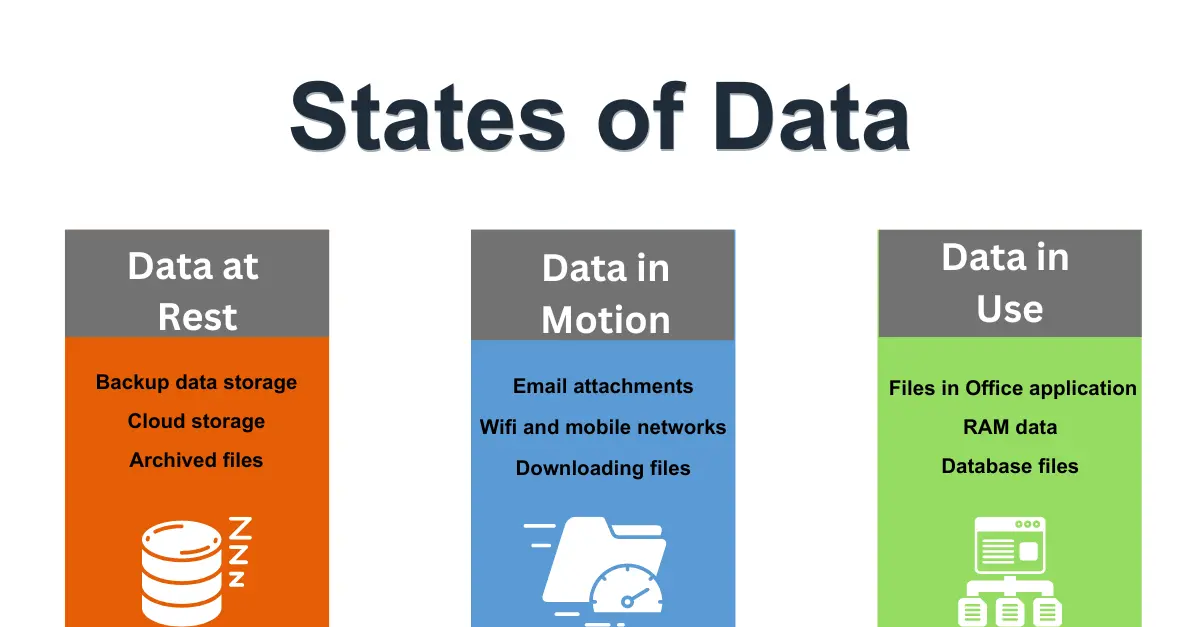
This piece provides key strategies to help you create a resilient data security plan focused on the three states of data: at rest, in motion, and in use.
Each state presents unique risks and opportunities for protection.
Protecting data across all three states is the type of security that involves protecting data in transit and storage together: organizations must secure data at rest, data in transit, and data in use as one coordinated strategy rather than treating each in isolation.
Understanding the Data Landscape: At Rest, In Motion, and In Use
Data security depends on the state your data is in — at rest, in motion, or in use. Once you understand these definitions, you can apply targeted protections for each.
Data at Rest
Data at rest is defined as information held on physical devices such as hard drives, servers, backup tapes, or cloud storage platforms, as well as on external storage devices and file hosting services. This includes databases, file servers, and even personal laptops that carry sensitive data, often referred to as inactive data or data stored.
While seeming static, data at rest is frequently a prime target for attackers due to its high value. Once attackers acquire access to a storage device or cloud platform, they can take massive volumes of data in one fell swoop. This is why it is critical to implement strategies to encrypt data, ensuring that unauthorized access is prevented and sensitive information remains protected.
For example, if an organization wants to improve the security of sensitive customer information stored on its servers, and that information is data at rest that is not currently accessed or processed, encryption is the method it should consider first. Encryption renders stored records unreadable without the correct key, which limits the damage even if the underlying server or storage volume is compromised.
Data in Motion (Data in Transit)
Data in motion refers to data that is actively traveling across networks through various communication channels such as email, instant messaging, and collaboration platforms. This includes file transfers, email exchanges, instant message exchanges, collaboration platforms, and remote desktop sessions. When data leaves its storage location, moving from one location to another, it is considered “in motion.”
Attackers can intercept data as it travels across networks if it is not properly secured. Data may be transmitted over a private network or other communication channels, each with unique security considerations. Unsecured Wi-Fi networks, unencrypted email connections, and out-of-date protocols can all make data in transit vulnerable to theft. Instant messaging, as a communication method, is particularly vulnerable to interception attacks if not properly encrypted.
Security teams investigating an incident often rely on network forensics to tell the difference between an issue with data in motion and one with data at rest: forensic analysis of live traffic (packet captures, session reconstruction, metadata) reveals how data moved and where it went, while forensic review of storage systems and logs reveals what was accessed while data sat idle. Both views are usually needed together to reconstruct a full incident timeline.
Data in Use
Data in use refers to information accessed, processed, or altered by authorized users. Data access during these activities must be secured, as it is critical to protect information while it is being read, processed, or modified. This may include a customer service person accessing a customer record, a data analyst running queries on a database, or an employee amending a document.
Human error, insider threats, and insufficient endpoint security can all expose data in use. Accidental data deletion, phishing attacks that fool users into disclosing important information, or malware on user devices can all jeopardize data security.
Now that you are clear on the data landscape, let’s dig deep into how data can be secured at its different states.
The biggest challenges in securing regulated and sensitive data
Key DLP compliance requirements
Modern DLP technologies that help prevent costly security incidents
How to Secure Data at Rest: Best Practices to Protect Stored Data from Breaches
To effectively safeguard your data at rest, a multi-layered approach is essential. Incorporating smart protection and risk management as key components ensures a proactive and effective data at rest security strategy. Here’s a breakdown of the key strategies:
Data at Rest Encryption
Encryption is the cornerstone of data security at rest. It operates as an impenetrable fortress, encrypting your data using complex algorithms, a process known as data encryption. Choosing the right encryption method is crucial to ensure your sensitive information is protected. Even if attackers get access to your storage systems, the encrypted data will be unreadable without the decryption key.
Consider storing your data in a safe vault that is only accessible to people who have the correct key. Industry-standard encryption techniques, such as AES-256, provide strong protection; AES-256 is a widely used symmetric encryption algorithm known for its high level of security. Implementing these algorithms ensures that even if attackers breach your defenses, the security of your data depends on the protection of encryption keys, making effective key management essential to prevent unauthorized access to encrypted data. Your data remains safe. Encryption algorithms and encryption methods must be chosen carefully to ensure compliance and robust security.
In the context of asymmetric encryption, a private key is used alongside a public key to securely encrypt and decrypt data at rest.
Of the options people usually weigh for protecting data at rest, such as strong access controls, cloud-based storage, regular password updates, or encrypting files and folders, encryption is generally the most recommended. It protects the data itself even if a storage volume is copied, stolen, or misconfigured, which access controls and password hygiene alone cannot do. The strongest posture treats encryption as the baseline and layers the other controls on top of it.
Access Controls
Not everyone should have access to your data vault. Access controls serve as attentive gatekeepers, carefully verifying the identity and authorization of any person attempting to enter. This includes two crucial components:
User Authentication: This guarantees that only authorized users have access to your data. Multi-factor authentication (MFA) extends beyond simple passwords by requiring a second verification element, such as a code sent to a trusted device. This dramatically minimizes the likelihood of unauthorized access, even if attackers have a user’s password.
Authorization (Role-Based Access Control): The concept of least privilege states that users should only have access to the data required to execute their jobs. Role-based access control (RBAC) precisely defines the data each person or group can access, preventing unauthorized users from accessing or altering critical information.
Consider assigning separate keys to different workers, some with access to certain areas of the vault and others to the full library. Regularly checking and upgrading access privileges ensures that only authorized people can access relevant data.
Data Masking and Tokenization
For highly sensitive data at rest, such as credit card numbers or social security numbers, consider adding an extra layer of obfuscation. This is when data masking and tokenization come into play.
TechniqueDefinitionHow It WorksExampleSecurity Impact
Data MaskingA technique that replaces sensitive data with fictitious values that resemble the original format.Sensitive data (e.g., credit card numbers, SSNs) is replaced with fake but realistic-looking data—maintaining format (e.g., number of digits) but holding no actual value.Credit card 1234 5678 9012 3456 becomes 9876 5432 1098 7654Masked data looks real but is useless to intruders attempting to steal meaningful information.TokenizationA technique that replaces sensitive data with random, unique tokens that have no intrinsic meaning or value.Real data is substituted with a token (e.g., random alphanumeric string). A secure, separate system holds the mapping between tokens and original data. Authorized users can access real data through this mapping if needed.SSN 123-45-6789 becomes X8Y7Z6W5T4Even if attackers steal the token, they cannot retrieve the real data without access to the secure token vault/mapping system.
Data Masking: This technique replaces sensitive data with fictitious values that seem like the original data format. Think of replacing credit card numbers with a sequence that retains the right amount of digits but has no actual value. While the masked data may appear convincing at first glance, it is basically useless to intruders attempting to steal real data.
Tokenization: This method goes one step further, replacing sensitive data with unique identifiers (tokens) that have no inherent meaning. Think of substituting the credit card number with a random alphanumeric string. A separate system securely holds the mapping between tokens and original data. This guarantees that authorized users can continue to work with the data while protecting the actual sensitive information from unauthorized users.
Implementing these strategies creates additional barriers for attackers, making it much more difficult to exploit stolen data.
What Measures to Take to Securing Your Data in Motion?
As data travels across networks, it becomes vulnerable to interception. When using any cloud service to transmit or store data in motion, it is important to evaluate the security measures provided by the cloud provider to ensure adequate protection. To safeguard your data in motion, consider these robust security measures:
Encryption for Data in Transit
Data in motion requires additional security. Encryption in transit serves as a secure tunnel, encrypting your data with protocols such as HTTPS and TLS/SSL. These protocols essentially form a virtual armored vehicle around your data, rendering it unreadable even if intercepted by malicious actors on the network. Imagine encrypting the shipment container itself, so that even if someone breaks into the vehicle, they will be unable to access the valuable items within.
This is how encryption in transit protects data during transmission: it wraps the data in a cryptographic layer before it leaves the sending system, so the content stays unreadable for the entire trip across the network and is only unlocked by the intended recipient. This is also what encryption secures in motion: login credentials, payment and financial details, personal and health records, internal communications, and any other information moving between users, applications, or locations.
Several categories of tools and technologies support secure, encrypted data movement across environments: TLS/SSL for web and application traffic, VPNs and secure tunneling protocols for site-to-site or remote connections, SFTP and other encrypted file-transfer protocols for bulk transfers, and cloud-native transit encryption offered by cloud service providers for data moving between regions or services. Pairing these with a network DLP or CASB layer helps confirm that encrypted channels aren’t being used to smuggle out sensitive data.
For organizations working across virtualized data centers, the same principle extends inward: traffic between virtual machines, hosts, and hypervisors should be encrypted and segmented just like traffic crossing the perimeter. Micro-segmentation, encrypted east-west traffic, and workload-level access controls secure data in transit and at rest within a virtualized environment, so that a compromised VM cannot freely reach every other workload or storage volume on the same host.
Network Security Measures
Think of your network as the highway itself. Just like traffic lights and security checks enable smooth and secure travel, network security measures protect your data in transit. Here are a few crucial components:
Firewalls: These serve as your network’s gatekeepers, meticulously inspecting incoming and outgoing traffic based on predetermined security criteria. They can block malicious traffic and unauthorized access attempts, ensuring that only authorized data passes across your network.
Intrusion Detection/Prevention Systems (IDS/IPS): These vigilant systems constantly monitor network activity for any unusual behavior that could suggest a potential attack. Imagine them as security cameras that are always scanning the highway for suspected activities. An IDS can detect such behavior, whereas an IPS can stop it, preventing attacks before they can compromise your data.
Network Segmentation: Breaking down your network into smaller, isolated zones is like constructing dedicated lanes for different types of traffic. This strategy reduces the possible damage if a breach occurs. Consider distinct lanes for high-value data transfers and general user traffic. If a security event occurs in one lane, it remains within that zone and does not spread to other important areas of the network.
Best practices for protecting data in motion from cyber threats generally combine several of the above at once: enforce encryption on every channel by default (not just for “sensitive” traffic), segment networks so a single compromised zone can’t reach everything else, keep IDS/IPS and DLP policies current, and require secure connections (VPN, encrypted Wi-Fi) for remote and hybrid work. A written remote work security policy that defines approved encryption standards and data handling rules for staff working outside the office closes many of the gaps that attackers rely on.
Data Loss Prevention (DLP)
DLP solutions, such as Fidelis Network Data Loss Prevention, serve as a final checkpoint on the data highway, specifically designed to prevent unwanted data exfiltration, with the protection of financial data and sensitive files as key objectives of DLP solutions. Consider DLP to be a squad of inspectors who thoroughly verify each shipment that leaves the network.
DLP can be set up to detect and prevent the transmission of sensitive data types (such as customer records and financial information) via email, file transfer, or other methods.
DLP policies can be set up to monitor specific keywords or data patterns, ensuring that only permitted transfers of sensitive information occur. Implementing these security measures creates a strong defense system for your data in motion, protecting it as it moves across your network infrastructure.
How Fidelis Helps Secure Data at Rest and Data in Motion
Fidelis Network® Data Loss Prevention protects data in motion using patented Deep Session Inspection® technology, which reconstructs full communication sessions rather than looking at isolated packets. It works with ICAP-compatible proxies and email/web sensors to inspect SSL/TLS-encrypted sessions alongside unencrypted channels. Rather than always decrypting content, it can also analyze TLS metadata, such as certificate details, cipher suites, session timing, and JA3/TLS fingerprints, to identify suspicious encrypted flows without breaking end-to-end encryption.
For data at rest, Fidelis Halo® (Fidelis’ CNAPP) integrates Data Security Posture Management (DSPM) capabilities alongside its Cloud Security Posture Management (CSPM), Cloud Workload Protection (CWPP), and container security components. It continuously scans cloud, server, and container assets for misconfigurations and compliance drift, and maps findings to frameworks such as PCI DSS, SOC 2, CIS Benchmarks, HIPAA, GDPR, and NIST 800-53, several of which include requirements to encrypt sensitive data at rest. Halo’s role here is posture visibility and compliance mapping rather than performing encryption itself. Used together, network-focused DLP and cloud-focused posture management give organizations two complementary lines of defense: one watching how data moves, and one watching the condition of where it’s stored.
Key Requirements
Solution Abilities
RFI Checklist
Data in Use: The Biggest Security Threat? Strategies to Empower Users
While robust technical controls are essential, human error and insider threats remain significant vulnerabilities for data in use. Attackers may exploit these vulnerabilities to steal data from within the organization. Here’s how you can empower your users to become active participants in data security:
User Education and Awareness Training
Empower your users to take an active role in data security. Teach them about best practices such as good password hygiene, identifying phishing attempts, and data classification (identifying sensitive data). Regular training programs keep people up to date on evolving cyber risks.
Antivirus, anti-malware, and application control software protect user devices (laptops, desktops, and mobile devices) that access your data. Updating software with the most recent security updates is critical for addressing vulnerabilities exploited by attackers. Monitor endpoints for any suspicious activity that could signal malware or unwanted access attempts.
Best practices for safeguarding restricted data extend the same idea to information with the highest sensitivity classification, such as regulated customer records or trade secrets: apply the strictest access controls and encryption to this data specifically, log and review every access attempt, and limit the number of people and systems that can touch it at all, whether it is at rest, in motion, or in use.
A Multi-Layered Defense for a Secure Future
Building a strong data security strategy necessitates a multi-layered approach. By combining the technical controls described above with a strong emphasis on user knowledge and best practices, you can significantly reduce the risk of data breaches. Remember that data security is a continual endeavor. Stay ahead of the curve by regularly monitoring your security posture, assessing emerging risks, and adapting your solutions.
For an organization planning to secure data across all three states, including large volumes of data it continuously transfers over the network, the most efficient and secure approach is rarely a single tool. It’s encryption applied consistently at rest and in transit, paired with DLP and network segmentation to watch how data actually moves, and access controls plus endpoint protection to cover data in use. Handling each state with a purpose-built control, instead of forcing one tool to cover all three, keeps both security and network performance intact as data volumes grow.
Schedule a demo to see why security teams trust Fidelis:
Patented DSI technology
Cut threat detection time by 9x
Provide unmatched visibility and control
Conclusion: The Ongoing Journey of Data Security
Protecting data is not a one-time project—it’s an ongoing journey that demands constant vigilance and adaptation. As technology evolves and new threats emerge, organizations must remain proactive in their approach to data security. This means regularly assessing risks, updating security measures, and staying informed about the latest threats and best practices.
A comprehensive data security strategy combines technical solutions—like encryption, access controls, and data loss prevention tools—with a strong culture of security awareness. Educating employees about smart classification, secure communication channels, and the dangers of human error helps prevent internal threats and accidental data breaches.
By prioritizing data security at every level, organizations can protect sensitive data, maintain compliance, and build trust with customers and stakeholders. Investing in robust security measures and fostering a culture of continuous improvement ensures that your organization is prepared to face the challenges of an ever-changing digital landscape. Ultimately, the commitment to data security is what sets resilient organizations apart, enabling them to protect data and thrive in a world where information is one of their most valuable assets.
Frequently Asked Questions
How does encryption in transit protect data during transmission?
It wraps data in a cryptographic layer, such as TLS/SSL, before it leaves the sending device, so the content is unreadable to anyone who intercepts it mid-transit. Only the intended recipient, holding the correct decryption key, can read the data once it arrives.
How can I ensure the security of data in transit across different networks?
Encrypt data by default on every network it crosses, including internal and virtualized environments, not just the public internet. Combine that encryption with network segmentation, IDS/IPS monitoring, and a clear remote-work security policy so employees connecting from outside the office follow the same encryption and data-handling standards.
What are the best practices for protecting data in motion, encrypting data at rest, and safeguarding restricted data?
Key technical terms mentioned in this article are linked below for further exploration:
The post Comprehensive Data Security: Protecting Data at Rest, In Motion, and In Use appeared first on Fidelis Security.
No Responses