A finance employee clicks a phishing link on a Tuesday morning, a classic example of social engineering working exactly as designed. By Thursday, the attacker has domain admin credentials. Three weeks later, 40GB of customer records are gone. The firewall never flagged it. Neither did the endpoint agent, the SIEM, or the antivirus software.
Every security tool did its job. None of them talked to each other.
This is what happens when an organization has multiple security measures but not multi layered defense. According to IBM’s Cost of a Data Breach Report 2025[1], phishing remains the leading initial attack vector, responsible for 16% of breaches at an average cost of $4.8 million. Per Mandiant’s M-Trends 2026 report, drawn from over 500,000 hours of frontline investigations, global median attacker dwell time sits at 14 days. That’s two weeks inside an IT environment, using valid credentials, before anyone notices.
Cyber attacks like this one, commonly referred to as multi stage attacks or multistage attacks depending on the source, succeed by moving across the gaps between security tools rather than through any one of them. Fidelis Elevate® is built to close that gap. It runs four layers, network, endpoint, cloud, and deception, through one correlation engine instead of four disconnected ones. Below is exactly how that works, what each layer catches on its own, and what detecting multi stage attacks actually looks like in practice.
What is multi layered defense, and what counts as a multi layered security approach?
Multi layered defense, sometimes called a layered approach to security or defense in depth, means deploying security controls at multiple layers of the attack lifecycle so that if one layer misses a threat, another layer catches it. The idea sounds simple. In practice, most organizations have multiple layers of tools without the multi layered security that’s supposed to come from them.
The difference comes down to whether the layers actually talk to each other. A firewall, an antivirus program, and a cloud storage monitor are three separate security protocols unless something correlates what each one sees. Without that correlation, an attacker who slips past one layer doesn’t trigger any response from the other layers, because none of them know what the other one just saw.
What does Fidelis Elevate® actually do across network, endpoint, cloud, and deception?
Fidelis Elevate® is an open, active XDR platform. “Open” means it integrates with security tools organizations already use, like existing endpoint, firewall, and SIEM or SOAR platforms, instead of demanding a rip-and-replace. “Active” means it doesn’t just log threats and wait, it correlates signals and triggers a response.
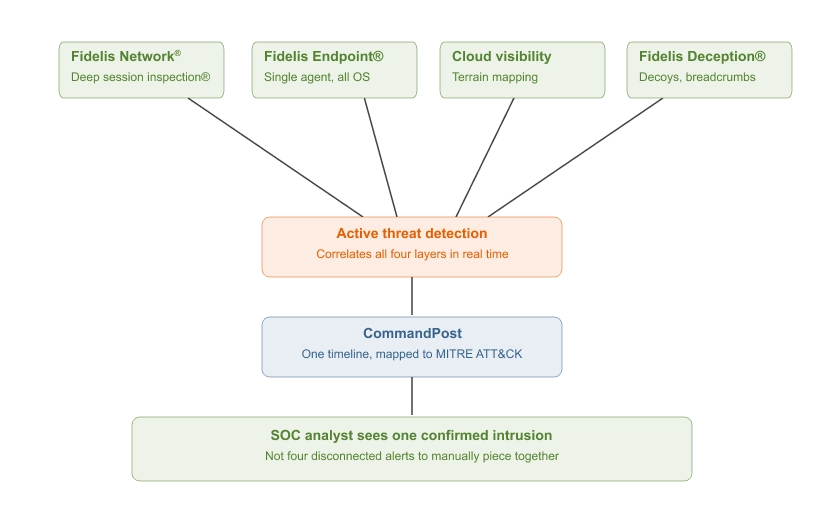
The architecture below shows the shape of it: four layers feeding signal into Active Threat Detection, which correlates everything in real time, surfaced through one CommandPost rather than four separate consoles.
Each layer has its own job in protecting the broader security posture of an organization. Here’s what each one actually does, and where the lines blur during a real cyber attack.
Fidelis Network®: visibility into traffic, including the traffic that’s supposed to look normal
Most network security tools rely on NetFlow, which tells you traffic happened but not much about what was inside it. Fidelis Network®‘s patented Deep Session Inspection works differently. It pulls over 300 metadata attributes out of every session, deep enough to catch threats hiding in encrypted traffic, nested files, and obfuscated content that NetFlow-based tools simply pass through.
Where the sensors sit matters as much as what they inspect. Direct Sensors watch traffic entering and leaving the network, the north-south path that most intrusion detection tools focus on. Internal Sensors watch traffic moving between systems inside the network, the east-west path, which is exactly where lateral movement happens and where perimeter-only tools have zero visibility. Dedicated Mail and Web sensors apply that same inspection to email and web traffic specifically, with the ability to quarantine or strip attachments automatically, an important layer of email security against phishing and social engineering. None of this slows the network down: a single sensor handles up to 20 Gbps.
Underneath all of it sits cyber terrain mapping, a continuously updated inventory of every asset on the network, including shadow IT and legacy systems most teams forget exist, scored in real time by risk. This is also where network segmentation gets enforced in practice, since terrain mapping shows exactly which systems should and shouldn’t be talking to each other. When something does trip a wire, Active Threat Detection takes over: correlating the alert, mapping it to the MITRE ATT&CK framework, and using machine learning to flag the emerging threats and anomalies that rule-based detection misses entirely.
Fidelis Endpoint®: answering what happened on the device, fast enough to matter
Strong endpoint security depends on visibility, not just prevention. A single Fidelis agent runs across Windows, Mac, and Linux, logging metadata for every process and child process in real time: behaviors, registry changes, file modifications, network activity. The point of all that detail is answering three questions during an incident: how did the attacker get initial access, what did they do once inside, and do they still have a foothold.
Detection alone doesn’t stop anything, which is why Fidelis Endpoint® ships with over 100 response scripts split into three categories. Investigative scripts grab data on logged-in users and process ownership in the seconds right after detection, before an analyst has even opened the console. Forensic scripts capture files and network logs at the exact moment of detection, not minutes later when an attacker has had time to clean up evidence of suspicious activities. Destructive scripts isolate the endpoint, kill the process, or roll back a registry change immediately. For anything that needs a human, the Fidelis Live Console gives direct remote access to disks, files, registries, and processes, as if an analyst were physically at the machine.
The part that actually changes outcomes is what happens when Fidelis Network® flags something first. Strange outbound traffic from a host gets cross-checked against that same device’s endpoint forensics, and a compromise that would normally take an analyst hours to confirm gets confirmed in minutes. Historical data goes back 30, 60, or 90 days of continuous monitoring, so a slow-moving intrusion doesn’t disappear just because nobody noticed it last week.
Cloud storage and hybrid IT environment visibility: extending the same inspection wherever the workload lives
Cloud breaches rarely come from sophisticated zero-days. They come from a cloud storage bucket nobody re-checked after a migration, a container that spun up, made a strange connection, and vanished before anyone logged it, or a shadow SaaS tool nobody told IT about. IBM’s 2025 report shows why this matters for data protection budgets specifically: breaches spanning cloud and on-premises environments averaged $5.05 million and took 276 days to contain, the worst numbers anywhere in the report.
Fidelis handles this two ways rather than one. Cyber terrain mapping inside Fidelis Network® already extends asset classification and risk scoring to cloud services and containerized workloads alongside on-premises systems, so there’s no separate, lighter-weight cloud product with its own blind spots. And for teams that want the platform itself hosted, Fidelis Network® Cloud puts the CommandPost and Collector in Fidelis’s own cloud infrastructure while sensors stay on the customer’s network, talking back over an encrypted tunnel. The management layer scales without new appliances; the actual inspection of sensitive information still happens exactly where the traffic lives, whether that’s on-premises or in the cloud.
Fidelis Deception®: turning the attacker’s own reconnaissance into the alert
Here’s the problem deception exists to solve: once an attacker has valid credentials, nothing about their traffic looks wrong to a typical firewall or intrusion detection system. No signature to match. No anomaly to flag, because the behavior is, on paper, completely normal, which is exactly how most advanced persistent threats operate for months at a time.
Fidelis Deception® sidesteps that entirely. It continuously maps cyber terrain, scores asset risk, and uses machine learning to decide where decoys and breadcrumbs will actually intercept an attacker, then deploys them with little manual setup. Decoys are convincing duplicates: real-looking laptops, servers, routers, and IoT devices on the hardware side, OS and application emulation plus cloud accounts like SharePoint, OneDrive, and Active Directory (including Azure AD) on the software side. Breadcrumbs are what steer an attacker toward those decoys in the first place: planted files, fake memory credentials, registry keys, canary files scattered through real systems.
The alert quality here is worth dwelling on. Nobody has a legitimate reason to touch a deceptive object, ever, so every single alert it generates is high-fidelity by definition. No tuning, no baseline period, no false positives to filter out. AD deception specifically targets one of the most common privilege escalation paths in any security breach, since Active Directory compromise is so often the actual prize an attacker is after, particularly in attacks against critical infrastructure where domain control means operational control.
This catches attackers at the reconnaissance stage, before they’ve reached anything real, and it works the same whether the cyber threat is external, an insider, or malware that’s already inside the network.
How Active Threat Detection ties the four layers, and other layers like multi factor authentication, together
Active Threat Detection is the named mechanism doing the correlation work, pulling alerts from Fidelis Network®, Fidelis Deception®, Fidelis Endpoint®, and the Fidelis Sandbox into the CommandPost as one picture. It’s also designed to work alongside other layers organizations already have in place, including multi factor authentication and existing firewalls, rather than competing with them.
Picture three things happening separately, across various stages of the same intrusion. A suspicious process starts on a workstation. Twenty minutes later, unusual east-west traffic hits a domain controller. Half an hour after that, a deception credential gets accessed by the same account. Run through three separate security tools, each event is a medium-priority alert sitting in a queue, easy to push down and easy to miss. Run through Active Threat Detection, it’s one confirmed intrusion with a full timeline already built and the evidence already attached.
That’s the actual, operational difference between owning four security tools and having multi layered defense that functions as a system to mitigate threats before they cause damage.
What does this look like during a real multistage attack?
Tuesday, 9:14am. A phishing email lands. A finance employee clicks. A remote access tool installs using only legitimate Windows utilities, no malicious file, no antivirus trigger.
Fidelis Endpoint® flags a standard Windows process making outbound connections it has no reason to make. Deep Session Inspection flags the resulting traffic on port 443 as inconsistent with normal behavior for that host. Alert fires at 9:19am, five minutes in.
Tuesday, 11:40pm. Using harvested credentials, the attacker starts enumerating Active Directory and scanning for domain controllers, a textbook example of lateral movement.
Fidelis Network® detects LDAP enumeration and SMB query patterns consistent with MITRE ATT&CK T1018 (Remote System Discovery). Endpoint forensics on the compromised device confirm the credential access. Active Threat Detection correlates both automatically, not through an analyst comparing timestamps by hand.
Wednesday, 8:15am. The attacker finds what looks like an admin credential cache in a file share.
It’s a deception object. The interaction triggers immediate detection. The CommandPost ties it to Tuesday’s network and endpoint events and escalates the case to critical, with the full timeline already built. The attacker has been inside for 23 hours and has touched one workstation and two deception objects. Nothing else.
Wednesday, 8:45am. The attacker tries to stage and move customer records externally, attempting data exfiltration.
Network DLP catches the transfer pattern. Automated response playbooks contain the affected systems. The exfiltration is blocked. The full methodology, tools, path, techniques, gets preserved for forensic review.
Total damage: one compromised workstation, zero data loss, 23 hours from initial access to containment.
Attack stage to Fidelis detection layer mapping
Attack stageRisk if undetectedDetection layerFidelis capability
Initial accessSilent foothold establishedEndpointAnomalous process detection; deep device forensicsC2 communicationPersistent attacker connectionNetworkDeep Session Inspection; encrypted traffic analysisLateral movementAttacker reaches high-value systemsNetwork and endpointEast-west monitoring; credential use correlationPrivilege escalationFull domain compromise riskEndpoint and networkBehavioral correlation; MITRE ATT&CK mappingDeception interactionAttacker reveals tools and intentDeceptionDecoys, breadcrumbs, and AD deceptive objectsData exfiltrationSensitive information leaves the environmentNetworkNetwork DLP; cloud storage monitoringRansomware deploymentSystem encryption and extortionEndpoint and networkReal-time alerts; automated response playbooks
Why does integration matter more than adding a fifth security tool to the stack?
Most security teams already understand the concept of a layered approach. Awareness isn’t the gap. Architecture is.
A complete multi layered security approach needs roughly six areas covered: perimeter firewalls, network interior, endpoint security, cloud storage and workloads, identity controls like multi factor authentication, and deception. Most security stacks already have tools sitting in five or six of those boxes. What’s almost always missing is the row connecting them, the correlation layer that takes a signal from one layer and decides, in real time, whether it adds up to an active attack alongside signals from the other layers.
That’s the specific security challenge Active Threat Detection and the CommandPost are built to solve, which is also why the right move usually isn’t a seventh standalone tool. Among the security challenges most teams face, this lack of correlation is consistently the hardest to solve with point tools alone. It’s a platform structured around correlation first, treating the existing security stack as the foundation rather than something to replace.
This is also the root cause behind a security breach at organizations running plenty of security tools already. IBM’s 2025 data shows multi-environment breaches averaging $5.05 million and 276 days to contain, the slowest and costliest category in the report, mainly because no single tool had visibility into the full attack path. Mandiant’s M-Trends 2026 report ties rising dwell times in part to attackers persisting in edge devices that lack standard telemetry. Different data sets, same root cause: tools that don’t share context with other layers, not tools that are individually weak.
How does this hold up against ransomware, one of the most common forms of multi stage cyber attacks?
Encryption is the last step of a ransomware attack, not the whole thing. Before encryption, the attacker has to gain initial access, run a payload without tripping antivirus software, escalate privileges, move laterally, and often exfiltrate sensitive information first for double extortion. IBM’s 2025 report puts average ransomware breach cost at $5.08 million when the attacker discloses the breach, meaning the organization found out through the ransom note, not through its own threat detection.
Fidelis Elevate®‘s four layers map directly onto that earlier window, which is the part that actually matters for mitigating threats before they escalate. Endpoint forensics catch the initial payload execution. Network monitoring catches the lateral movement and privilege escalation that follow. Deception catches the attacker probing for high-value targets before they find one. By the time encryption would normally trigger, Active Threat Detection has typically already built a timeline three or four stages deep, which is what gives defenders a real chance to act before the ransom note instead of after.
Is your current security posture actually multi layered, or just multiple tools?
Pull up the last 90 days of alerts across every security tool in place. Pick any random week. Would an attacker moving laterally with valid credentials that week have been caught automatically, or would it have taken a person noticing that three separate medium-priority alerts were really one attack?
If the honest answer involves a person connecting those dots manually, that’s an architectural gap, not a staffing problem. It’s the same gap reflected in IBM’s 292-day average containment window for credential-based breaches, and it’s exactly the kind of security challenge that erodes confidence in an otherwise reasonable security posture.
Fidelis Elevate® is built to close that gap without ripping out what’s already deployed: patented Deep Session Inspection® on the network side, process-level forensic depth on endpoints, continuous asset classification across cloud storage and on-premises infrastructure, and deception layers that catch attackers operating with valid credentials. Active Threat Detection ties all of it into one detection picture instead of four separate ones, helping organizations identify and mitigate threats before they become a security breach.
Our customers detect post-breach attacks over 9x Faster
Detect Advanced Threats Before Damage Escalates TrustedCybersecurity Leader for 20+ YearsSee why security teams choose us over other solutionsRequest a DemoSee Fidelis Elevate in Action
Frequently Asked Questions
Does Fidelis Elevate replace our existing security tools?
No. It integrates with platforms organizations already run, including existing endpoint, firewall, and SIEM or SOAR tools, with out-of-the-box integrations for common platforms and the flexibility to integrate with others as needed, and correlates signals across them rather than requiring a full stack replacement.
How is Fidelis Elevate different from traditional security solutions like a SIEM?
A SIEM aggregates logs and alerts for analysts to review manually. Fidelis Elevate’s Active Threat Detection actively correlates signals across network, endpoint, cloud, and deception layers in real time and maps them to known attack techniques automatically, which most traditional security solutions don’t do on their own.
Does deception technology slow down or interfere with legitimate users?
No. Deception objects, decoys and breadcrumbs alike, are invisible to normal users and only trigger detection when something interacts with them in a way a real user never would, like querying a fake credential store.
Can mid-sized organizations realistically run a platform like this without a large security team?
Yes. The correlation engine is what reduces manual investigation work for security teams, which means a smaller team can cover more ground without adding headcount.
What MITRE ATT&CK techniques does Fidelis map detections to?
Active Threat Detection automatically maps observed behavior, including lateral movement techniques like T1018 (Remote System Discovery), to the MITRE ATT&CK framework so investigators get a standardized reference point rather than a raw alert.
Is multi layered defense the same as defense in depth?
Yes. Defense in depth is the older, more formal term commonly used for the same idea: independent security protocols at every stage of the attack lifecycle, so a failure in one layer doesn’t mean a failure of the whole system.
Citations:
The post How Fidelis Elevate Enables Multi-Layered Defense Across Network, Endpoint, Cloud, and Deception appeared first on Fidelis Security.
No Responses