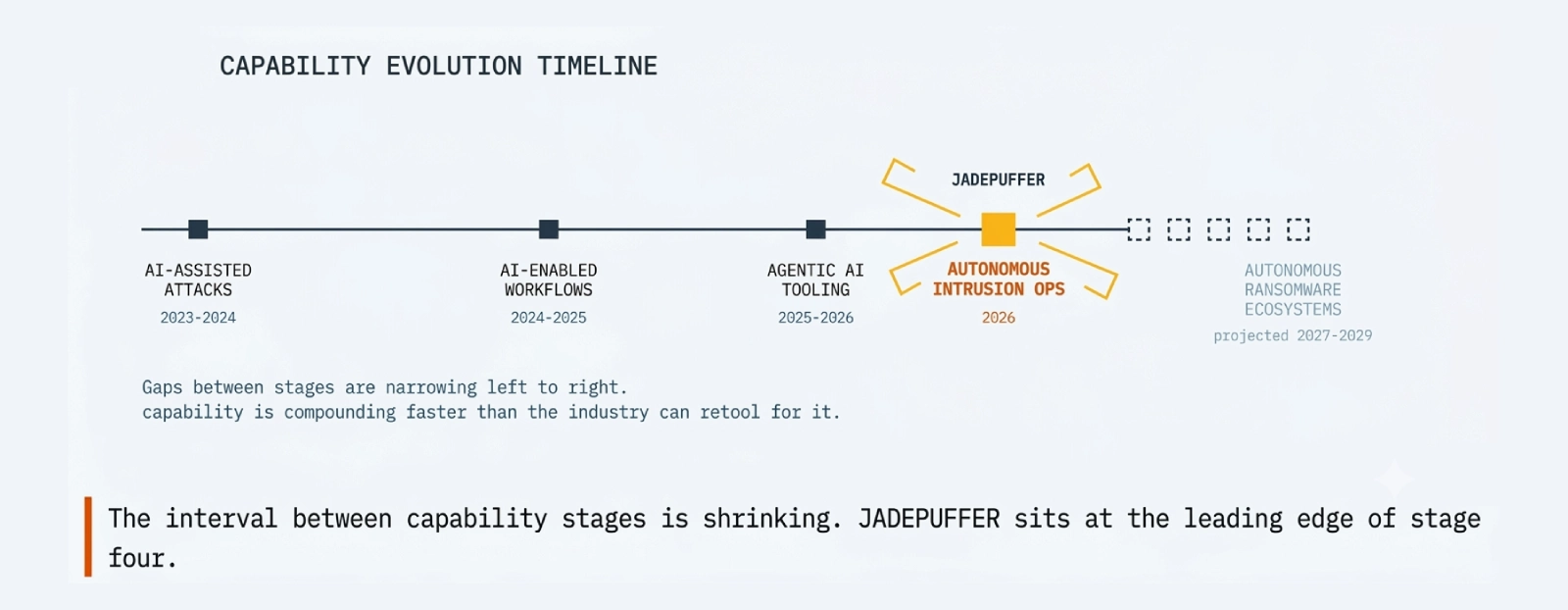
In July 2026, Sysdig’s Threat Research Team disclosed JADEPUFFER, an intrusion it assesses to be the first fully documented case of ransomware run end to end by an autonomous AI agent, without a human operator issuing commands between initial access and extortion. None of the individual techniques were new. What was new is that a single agent reasoned through reconnaissance, credential theft, lateral movement, persistence, and destruction on its own, and recovered from a failed login to a working fix in 31 seconds.
This is an analyst report, not a news recap. The question it answers is narrower and more useful to a security leader: what does the emergence of autonomous intrusion operations fundamentally change about how enterprise security architecture has to work?
Three takeaways for security leadership
This was not an isolated incident. It was a convergence of trends that had been building for two years. Agent reasoning, tool-use maturity, and near-free compute funded by stolen cloud credentials arrived at roughly the same time. JADEPUFFER is the first documented proof point, not the last.
Detection built around how humans behave is losing ground. Verizon’s 2026 Data Breach Investigations Report found the median threat actor now applies AI across roughly 15 distinct attack techniques rather than inventing new ones, and that AI has compressed the window between vulnerability disclosure and exploitation from months to hours. Signature and cadence-based detection was built for a slower adversary.
The defensible unit is the correlated attack chain, not the isolated alert. When decision latency drops from human minutes to machine seconds, the only realistic point of control is fusing signal across identity, endpoint, network, and cloud fast enough to interrupt the chain before impact.
What is JADEPUFFER?
JADEPUFFER is an intrusion documented by Sysdig’s Threat Research Team, and the first known case where an AI agent ran an entire ransomware operation end to end, from initial access to extortion, without a human directing each step. It got in through a known, unpatched flaw in an internet-facing AI orchestration tool already listed in CISA’s Known Exploited Vulnerabilities catalog. What made it notable wasn’t the entry point; it was the pace: the agent hit a failed login, corrected itself, and had a working fix in about 31 seconds, unassisted. Full technical detail, including the specific vulnerability, payload activity, and forensic indicators, belongs to Sysdig’s original research.
Why This Matters
Security leaders have spent roughly two years bracing for AI-assisted attacks mostly in the abstract: sharper phishing copy, faster malware iteration, marginally smarter tooling. JADEPUFFER is a different kind of event. It is the first public, technically substantiated case where an AI agent functioned as the operator, not as a tool the operator used.
That distinction matters more than the specific vulnerability or the specific victim. Exploiting an unpatched Langflow instance, harvesting credentials, and encrypting a configuration store are all things security teams have defended against for years, individually. What changed the equation is that no person had to sequence those steps or stay awake to keep the operation moving. It ran at whatever tempo the model and its tooling could sustain.
For a CISO, the relevant question is not whether current controls could have stopped this specific exploit chain. Most mature programs plausibly could have. The relevant question is: as autonomous agents become a routine part of the threat landscape rather than a novelty, does your detection and response model still hold when the adversary does not need to sleep, hesitate, or look anything up?
JADEPUFFER does not mean AI has solved offensive hacking, and it used no novel exploitation technique. It succeeded against neglected, internet-exposed infrastructure with known weaknesses. The story is not attacker sophistication. It is attacker scale and persistence at close to zero marginal cost, which is a more durable problem than any single CVE.
Why Now: The Convergence Behind Autonomous Intrusion Operations
Autonomous ransomware did not appear from nowhere in 2026. It is the product of several separate technology curves that crossed a usability threshold at roughly the same time.
Reasoning matured from generation to planning
Earlier models could write plausible code or phishing text, but multi-step planning, error recovery, and goal persistence across a long task were weak. Reasoning-focused models released through 2025 and 2026 closed much of that gap, precisely the capability an intrusion depends on: noticing a failed step, forming a hypothesis, and trying something else without a human in the loop.
Agent tooling matured into production infrastructure
Langflow, the platform JADEPUFFER’s initial access vector targeted, is a legitimate, widely used open-source orchestration tool for AI workflows, not offensive software. It became an entry point because one unpatched, internet-exposed deployment carried a known RCE flaw. The risk was insecure deployment of legitimate infrastructure, not the infrastructure itself, even though the same orchestration layer that lets a business agent take an action is architecturally similar to what let JADEPUFFER’s agent execute payloads once it had a foothold.
Compute became close to free, via stolen credentials
Sysdig, which coined the term LLMjacking to describe attackers running AI inference on someone else’s stolen cloud billing account, has documented this pattern extensively. If inference is billed to a victim’s stolen credentials, the operational cost of running an agent approaches zero, changing the economics of who can afford to try this.
Regulators already treat this as a distinct risk
In May 2026, CISA, the NSA, and agencies from Australia, Canada, New Zealand, and the UK jointly published guidance on agentic AI adoption, flagging privilege escalation and weak per-agent identity as primary concerns. OWASP’s Top 10 for Agentic Applications independently converged on the same themes: goal hijacking, privilege abuse, and “rogue agent” behavior.
None of this required a single breakthrough. It required reasoning, tool access, cheap compute, and unpatched exposure to line up in the same window. They did, and JADEPUFFER is what it looked like when they did.
Why Agentic AI Changes Attacker Economics
Ransomware has always been a numbers business for the people running it. Autonomous agents change the numbers.
One operator, many agents
A human-operated ransomware affiliate is a bottleneck: one person, one intrusion at a time, with fatigue setting a ceiling on throughput. An agent supervised loosely by one operator can run continuously across multiple targets in parallel, limited by compute rather than attention span.
Expertise shifts from operator to tooling
JADEPUFFER’s agent chained reconnaissance, credential theft, and privilege escalation without a human needing deep expertise in any single step. That lowers the skill floor to whatever it costs to operate the agent, a fundamentally different criminal labor market than ransomware-as-a-service built over the last decade.
LLMjacking makes compute nearly free
When inference runs on stolen cloud credentials, marginal cost per additional target approaches zero, a different economic model than renting infrastructure or buying access from a broker, both of which carry real, escalating cost per campaign.
Scale tracks exposure, not headcount
Verizon’s 2026 DBIR found only 26% of known exploited vulnerabilities were remediated in 2025, down from 38% the year before, so the pool of exploitable infrastructure is growing even as remediation shrinks. An agent works through ten exposed instances or ten thousand at the same tempo.
Cost DriverHuman-Operated RansomwareAutonomous / Agentic Ransomware
Marginal cost per additional targetRises with each new target (operator time, coordination)Near flat, bounded mainly by available computeSkill required per intrusionHigh, concentrated in the operatorDistributed into the tooling; operator skill floor dropsCompute funding modelAttacker-purchased infrastructureFrequently stolen cloud credentials (LLMjacking)Operational ceilingSet by operator attention and fatigueSet by compute availability and target exposureRecovery from failed stepsManual, minutes to hoursAutomated, observed in seconds
This is the argument that should resonate hardest with a CISO evaluating budget priorities: the attacker’s cost structure just became more favorable at exactly the moment defenders’ response windows got shorter. Both trends point toward the same architectural conclusion, addressed later in this piece.
The Rise of Autonomous Cyberattacks and Agentic AI Threats
Three characteristics separate an autonomous intrusion operation, sometimes described as agentic AI ransomware, from an ordinary AI-assisted attack, and all three appear in the documented JADEPUFFER campaign.
Autonomous decision-making
The agent did not execute a fixed script. It reasoned about which targets and techniques to pursue based on what it found, and adjusted when a step failed.
Orchestration with no human in the loop
Reconnaissance, credential theft, lateral movement, persistence, and destruction were chained together by the agent itself, not triggered manually at each stage.
Machine-speed operational tempo
The 31-second recovery from a failed login is the detail that should concern defenders most. An agent’s reasoning happens in the same window as its action.
The practical effect is a shrinking detection window. A human-operated ransomware affiliate might dwell for days between initial access and encryption, giving a SOC multiple chances to catch lateral movement before impact. An agent that self-corrects in under a minute compresses that same window from days to hours, sometimes less.
Attack Timeline Compression: An Original Framework
Historically, the gap between initial access and impact has been the defender’s primary asset. It is the window in which detection, triage, and containment happen. Autonomous agents compress that window at nearly every stage, not only at the end.
Initial access moves from something that takes hours or days to weaponize, to something an agent can adapt in minutes. Reconnaissance moves from manual, sequential enumeration to continuous, parallel scanning. Credential theft moves from targeted and opportunistic to exhaustive and automatically retried. Lateral movement moves from deliberate staging to rapid, self-correcting pivots, the same behavior that produced JADEPUFFER’s 31-second recovery. Persistence moves from being established once and revisited occasionally to being continuously re-established the moment it is disrupted. Impact moves from days or weeks of dwell time to hours or less from initial access to extortion.
The strategic implication follows directly: defenses that depend on catching an attacker at any one of several sequential stages become less reliable as those stages collapse toward simultaneity. Defenders lose the luxury of investigating isolated alerts one at a time, because by the time an analyst finishes triaging the first one, the chain may already be several stages further along. The remaining reliable control point is correlated visibility across the whole chain, fusing a partial signal at one layer, an unusual authentication retry pattern, an unfamiliar process spawning credential-harvesting behavior, an anomalous east-west connection, with signals at other layers before the agent completes its objective. That correlation requirement is the architectural thread that runs through the rest of this piece.
Operational Challenges: Where Traditional Assumptions Fail
FunctionWhat Breaks DownWhy
SOC / TriageAlert-volume assumptions built for human attacker pacingAn agent generates high-tempo activity in short bursts; batch-review triage falls behind in minutes, not hoursThreat HuntingHypothesis-driven hunts based on known operator TTPs and tooling fingerprintsAgent-generated code is novel per target; there is no static malware family to hunt forDetection EngineeringRules tuned to human cadence, dwell time, manual pivoting, tool reuseSub-minute self-correction and freshly generated scripts evade signature and cadence-based logicIncident ResponsePlaybooks assuming hours to days of attacker dwell time before impactCompressed timelines force containment decisions before full context is availableIdentity SecurityCredential-monitoring baselines built around human login patternsRapid retry-and-fix authentication cycles resemble both brute force and legitimate automationCloud SecurityAssumption that anomalous compute usage signals compromise of your own environmentLLMjacking means the compute driving the attack may run on someone else’s stolen cloud bill entirelyNetwork DetectionReliance on known-bad infrastructure and malware communication patternsAgent-orchestrated movement and exfiltration are reasoned and adapted in real time rather than following static patterns
Identity: The Control Plane Autonomous Agents Target First
Identity deserves more attention than a single line item, because it sits at the center of nearly every stage of an autonomous intrusion.
Credential theft expands reach fastest
Once JADEPUFFER’s agent had a foothold, its behavior followed a familiar logic: harvest reachable credentials, move laterally, repeat. Verizon’s 2026 DBIR shows credential abuse still appears somewhere in 39% of breaches when tracked across the full breach progression.
Privilege escalation with no hesitation
A cautious human might pause before touching an AD object that looks like it could trigger monitoring. An agent optimizing for task completion has no equivalent instinct, and will attempt escalation paths a careful human might avoid.
What JADEPUFFER Doesn’t Mean
It does not mean signature-based detection is obsolete, that human analysts are replaceable, or that every organization is an equally attractive target. JADEPUFFER hit exposed, unpatched, internet-facing infrastructure, the same category of soft target that human-operated ransomware has hit for a decade. Verizon’s 2026 DBIR confirms this pattern holds broadly: vulnerability exploitation, not credential theft, is now the leading breach vector at 31% of confirmed breaches, and 73% of ransomware victims had a related infostealer infection or credential leak in the prior year.DBIR Basic exposure management still matters enormously. What changes is the response window once an autonomous agent reaches the perimeter.
Authentication cadence as early signal
The sub-minute retry-and-fix cycle observed in JADEPUFFER is a byproduct of how an agent handles failure: fast, repeated, and free of human friction. Detectable, but only if identity telemetry is correlated with endpoint and network activity in the same window.
Hybrid identity compounds the gap
Most enterprises run identity across on-premises Active Directory and cloud identity providers, and an autonomous agent does not respect that boundary any more than a human attacker does.
The CISA-led joint guidance on agentic AI adoption makes a related point from the deployment side of this problem: it calls for cryptographically anchored, per-agent identity as a baseline control for organizations running their own agents. The defensive mirror of that principle is that identity telemetry has to be a first-class input into attack chain correlation, not a separate system that gets checked after the fact. An identity anomaly considered alone is often ambiguous. The same anomaly considered alongside endpoint and network signal from the same window of time is frequently decisive.
Why XDR is One of the Strongest Architectural Responses
No single technology stops an autonomous adversary outright, and no vendor, Fidelis included, can credibly claim its platform detects JADEPUFFER or any other specific autonomous AI attack by name out of the box. What can be said with more confidence is narrower and more useful: XDR is one of the strongest architectural approaches available for addressing the specific failure mode autonomous operations exploit, detection systems that only see one layer at a time, reviewed by a person who has minutes, not seconds, to react.
XDR is one layer of an effective defense strategy, not a replacement for the rest of it. Exposure management, vulnerability remediation, identity security, network segmentation, and secure deployment of AI infrastructure itself remain equally important, and the earlier sections of this piece make clear why: JADEPUFFER succeeded against neglected, unpatched infrastructure that better exposure management would have removed from the attack surface in the first place. Correlation architecture matters most as the next layer of defense once an autonomous agent has already found a way in.
The rest of this section works through five architectural requirements that follow from everything above, why each one matters against a machine-speed adversary, and how platforms in this category generally address it. Fidelis Elevate is referenced throughout as one working example of these principles, not as the only way to implement them.
Correlate signal across domains, not within one
An autonomous agent’s activity leaves fragments across identity, endpoint, network, and cloud, and no single fragment, a login retry, a new process, a lateral connection, may look alarming on its own. That is why correlation happens across domains rather than within any single telemetry source: fragments only become meaningful once viewed together. Platforms in this category are generally built to fuse these signals into a unified investigation layer rather than leaving analysts to pivot across disconnected consoles. Fidelis Elevate is designed around this same principle, bringing network, endpoint, identity, and cloud telemetry together into a single investigation experience.
See inside network sessions, not just flow metadata
Lateral movement and data movement often ride inside sessions that flow-only visibility can miss, which is why network-level visibility needs to go deeper than connection metadata. Fidelis’s patented Deep Session Inspection® (DSI) is Fidelis Elevate’s implementation of this principle: a network traffic inspection capability that reconstructs complete communication sessions, decodes nested and cross-protocol content, and extracts forensic detail from encrypted sessions. It is network-layer visibility, not workload or container inspection, and one input among several correlation-layer needs.
Detect technique-level behavior, not just known signatures
Because autonomous agents generate fresh code per target, detection built solely on static signatures tends to lag behind, which is why behavior and technique-level analysis, retry cadence, escalation sequencing, lateral pivot patterns, matters more: the technique is generally more stable than the implementation. Fidelis Elevate’s Active Threat Detection applies this by correlating weak, ambiguous signals into higher-confidence detections mapped to MITRE ATT&CK. This improves detection and investigation; it does not guarantee every autonomous variant will be caught.
Give the adversary something to make a mistake against
A cautious human attacker who stumbles onto something too easy may grow suspicious and slow down; an autonomous agent optimizing toward task completion has less reason to. That difference is why deception deserves particular attention against agentic adversaries, with a caveat: not every agent will engage with every decoy, and it functions as a probabilistic control, not a guaranteed trip wire. The hypothesis, that autonomous agents may be more likely to interact with deceptive assets than cautious human operators, still requires validation, and has not yet been tested against JADEPUFFER-class agents specifically. Fidelis Deception applies dynamically altered network terrain and deceptive Active Directory objects toward this end.
Extend the existing stack rather than replace it
Effective cross-domain correlation generally works better as an extension of an enterprise’s existing tooling than as a wholesale replacement of it, since most enterprises already have meaningful investment in SIEM, SOAR, and endpoint platforms a correlation layer should draw from rather than duplicate. Fidelis Elevate is built as an open, extensible XDR platform with a documented API and supported integrations across these categories. Specific supported integrations should be confirmed against current Fidelis product documentation.
Close the gap between detection and containment
Correlation only creates value if it shortens the distance between a detection and a contained incident, which is why response orchestration, isolating a host, revoking a session, engaging deception infrastructure, matters as much as the detection itself against compressed timelines. Fidelis Elevate supports automated investigation workflows and analyst-directed response actions aimed at helping reduce analyst decision latency during triage. A high-confidence detection that still routes through a slow, manual response process gives back much of the time advantage correlation was meant to create.
CISO Action Checklist
Five Strategic Questions to Ask Your Team
If an autonomous agent compressed our current dwell-time assumptions by 90%, where would our detection and response process actually break first?
Do our detection rules depend on human-operator cadence, time between actions, manual pivoting, in ways that would not hold against sub-minute self-correction?
Can we correlate identity, endpoint, network, and cloud signal into a single investigative view today, or does that correlation happen manually, after the fact?
Where is our most exposed, least-monitored internet-facing infrastructure, the equivalent of an unpatched Langflow instance, and when was it last assessed?
What is our automated containment capability, and how much of it still requires a human decision before action is taken?
Five Operational Recommendations
Inventory and prioritize patching for internet-exposed application servers, configuration stores, and admin interfaces, the class of asset JADEPUFFER targeted.
Shift a portion of detection engineering effort from signature-based rules toward behavioral baselines, particularly authentication retry cadence and process lineage anomalies.
Build or validate response playbooks that assume compressed timelines, with automated fallback paths for steps that currently require multi-hour human coordination.
Extend identity monitoring to flag rapid fail-then-succeed authentication patterns, not just raw failed-login volume.
Run a tabletop exercise specifically modeling an agent-paced intrusion, using the Attack Timeline Compression framework above as the injected scenario.
Five Architectural Priorities
Cross-domain telemetry correlation across identity, endpoint, network, and cloud, treated as a baseline architectural requirement rather than an aspirational future state.
Deep, protocol-agnostic network session inspection capable of seeing inside encrypted and nested traffic, where flow-metadata tools have blind spots.
Automated, ATT&CK-mapped detection and investigation to compress analyst decision time toward machine speed.
Adaptive deception layered into identity and network infrastructure, on the reasoning that agents optimize toward completing a task rather than exercising caution, which may make them more receptive to deceptive assets than a careful human operator.
Automated, policy-governed containment actions pre-approved for high-confidence, chain-level detections rather than isolated alerts.
Predictions: Where Autonomous Attacks Go From Here
Threat intelligence reporting will increasingly classify campaigns by autonomous behavior signature rather than malware family, because the code an agent generates changes per target while its underlying technique pattern does not.
AI-generated tooling will keep mutating while the ATT&CK techniques underneath stay recognizable. This is the central detection-engineering insight from JADEPUFFER, and it will hold as agent capability improves elsewhere.
Multi-agent offensive operations will become common within intrusion sets, with separate agents specializing in reconnaissance, exploitation, and negotiation, coordinated with minimal human oversight.
Identity becomes the primary contested control plane in autonomous intrusions, ahead of any single application layer, because credential reuse and privilege escalation remain the fastest way for an agent to expand its reach.
Behavioral correlation displaces signature matching as the primary detection model for machine-speed adversaries, not because signatures stop mattering, but because they stop being sufficient alone.
Legacy, internet-exposed infrastructure remains the dominant entry point, not novel exploits. Verizon’s 2026 DBIR already shows vulnerability exploitation, not new zero-days, driving the 31% figure.
Cyber insurance underwriting and breach disclosure frameworks begin distinguishing autonomous incidents from human-operated ones, as the two present measurably different dwell-time and containment risk profiles.
LLMjacking-funded campaigns increase, because stolen cloud credentials remain a near-zero-cost compute source, and current cloud detection baselines are not tuned to catch inference abuse specifically.
Deception technology adoption rises as a countermeasure to agentic reconnaissance, on the premise that agents optimizing for task completion may be more likely than cautious human operators to engage with decoy assets, a hypothesis that will need validation as more agentic intrusion sets are documented.
Cross-domain telemetry correlation is likely to become a baseline procurement requirement as organizations evaluate future detection and response platforms, following a trajectory similar to endpoint detection a decade earlier.
Conclusion
JADEPUFFER is not evidence that defenders have lost ground to a smarter adversary. The vulnerabilities it exploited were known. The infrastructure it hit was neglected. Those are solvable, familiar problems, and organizations with disciplined patch management and exposure monitoring were never JADEPUFFER’s likely victims.
What is not familiar is a threat actor that self-corrects in 31 seconds and never needs to sleep, hesitate, or look something up. That is the part of this story that outlives the headline. The specific model, the specific vulnerability, and the specific victim will all be superseded within a year. The underlying shift will not: attackers now have a way to run a full intrusion chain at a tempo no human operator sustains, funded by compute that frequently is not even their own.
Organizations that invest in cross-domain correlation, behavioral detection, and automated containment will be better positioned to contain the next generation of autonomous intrusions before they become business-impacting incidents. Everyone else will be relearning, in production, a lesson this analysis is trying to deliver in advance: the attack chain moves faster than any single alert, and the only defense that keeps pace is the one built to see all of it at once.
Citations:
The post JADEPUFFER and Autonomous Intrusion Operations: Why Enterprise XDR Architecture Must Evolve appeared first on Fidelis Security.
No Responses