Key Takeaways
Insider threats now operate within trusted environments, making detection significantly harder than external attacks.
Visibility gaps, not detection gaps, are the primary reason insider incidents take longer to contain.
Deep session inspection enables full-context visibility across all traffic, not just fragments.
UEBA and continuous behavioral monitoring help identify slow, multi-stage insider activity early.
Integrated deception reduces false positives and accelerates high-confidence detection.
Network-level DLP and sandboxing prevent data exfiltration across encrypted and fragmented channels.
Faster detection and response directly reduce breach costs and dwell time.
The cybersecurity perimeter has fundamentally dissolved. As we move through 2026, organizations are grappling with a reality where decentralized AI agents, sprawling cloud-native architectures, and a hyper-mobile workforce have made traditional defenses look almost quaint. The most significant security risks no longer stand outside the gates. They are already inside, operating with legitimate access and often without a trace.
The numbers are hard to ignore. According to the 2026 Cost of Insider Risks Global Report by Ponemon Institute/DTEX (February 2026), the average annual cost of managing insider-related incidents has reached $19.5 million per organization, a 123% increase since 2018. For North American enterprises, that figure climbs to $24.2 million. And despite measurable advances in AI-assisted security, organizations still spend an average of 67 days containing a single insider event, per IBM Security’s Cost of a Data Breach Report 2025. Sixty-seven days. That is not a detection problem. It is a visibility and response problem.
Effective insider threat detection is no longer a secondary security function. For most organizations, it is the operational core of resilience.
Why 2026 Demands a Different Approach to Insider Risk Management
The shift is not just about volume. Complexity is the real driver, specifically the ways that new working patterns and unsanctioned tooling create insider threat risks that most security programs were never designed to catch.
Shadow AI is a good example. 72% of enterprise generative AI usage runs through personal, unmonitored accounts. This means security teams have no visibility into what data is moving or where it is going. The same report found that 47% of GenAI platform users access these tools through credentials their organizations are not overseeing at all.
Employees are using unauthorized AI platforms and autonomous agents to move data across business units, sometimes with no malicious intent at all. That last part is what makes it hard. Unauthorized data access does not always come with obvious signals.
Standard EDR and basic DLP tools were not built to answer the question of whether an AI-assisted data movement represents a legitimate automated process or the beginning of an insider threat incident. They lack the network-level ground truth to see a full session. So they catch symptoms.
There are also real distinctions between the common insider threat scenarios organizations face. Negligent insider threats, where employees inadvertently expose sensitive data through careless data movement or misconfigured access controls, are the most frequent. Malicious insider threats, where a current or former employee deliberately abuses authorized access for data theft or sabotage, tend to produce the costliest individual incidents.
Then there are potential insider threats who have not yet acted but are already showing behavioral signals. And compromised accounts, where external attackers operate on stolen employee credentials, blur the line between insider risks and external threats entirely. A robust insider threat program has to address all four. Most traditional security tools are built for maybe one.
Capability Comparison: Fidelis vs. Traditional Security Tools
FeatureTraditional Security ToolsFidelis Network® Solution
Inspection DepthPacket-level (DPI); misses full contextPatented Deep Session Inspection (DSI); full session reassembly across all ports and protocolsProtocol CoverageTop 50 to 100 common protocols300+ metadata attributes captured per session; all-ports, all-protocols coverageAlert FidelityHigh false positives; static signature rulesIntegrated Deception solution via Fidelis Elevate®, XDR; high-fidelity alerts from decoy interactionsDetection SpeedDays to weeks for complex threatsPost-breach detection up to 9x faster; automated retrospective analysis via metadataVisibility ScopeSiloed across Cloud, Endpoint, and NetworkUnified Cyber Terrain mapping across cloud, on-premises, endpoints, and IoTMITRE Framework AlignmentLimited or manual mappingAutomated MITRE ATT&CK and MITRE Shield alignment built into the platform
Core Capabilities for Effective Insider Threat Detection
1. Patented Deep Session Inspection (DSI)
Here is the core problem with most threat detection approaches: they look at fragments. Deep Packet Inspection examines isolated pieces of traffic, which works for signature-matched threats with known patterns. Malicious insiders specifically exploit this limitation. Non-standard ports, obfuscated channels, slow and deliberate data exfiltration staged over weeks. These are not accidents. They are methods chosen because fragmented inspection cannot reconstruct a full picture.
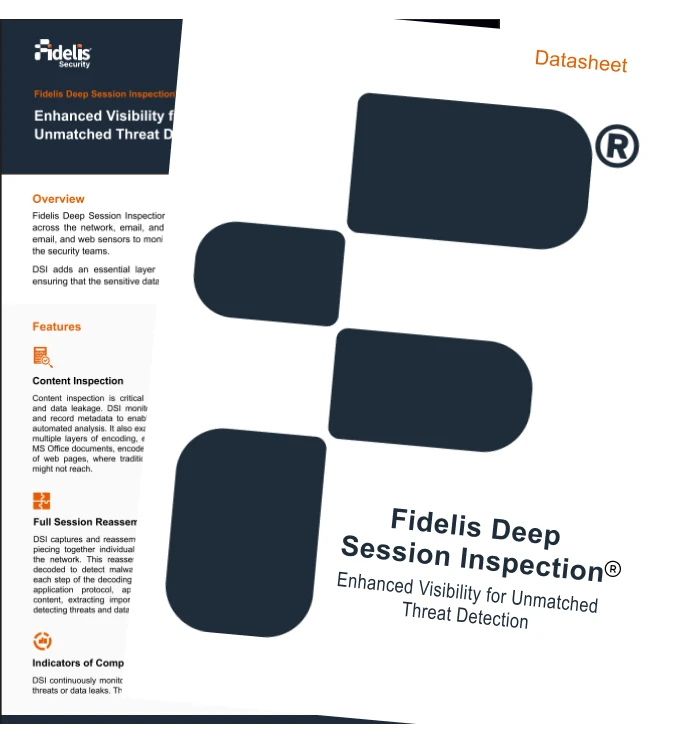
Fidelis Network® uses patented Deep Session Inspection technology that reassembles entire communication sessions in real time, regardless of port, protocol, or whether content is nested, compressed, or encrypted. This captures more than 300 metadata attributes per session, including filenames, hashes, protocol attributes, specific user activity, building a forensic record that NetFlow-based tools simply cannot produce.
What that means practically for security teams:
Full session context: Reconstruct exactly what sensitive data moved, when, and through what path. This is the difference between a suspicious signal and actual evidence.
Non-standard port visibility: Insiders tunneling data through uncommon ports or encoding it inside legitimate protocols are visible where DPI goes blind.
Retrospective analysis: New threat intelligence can be applied to stored session metadata automatically. A compromise indicator discovered today gets checked against months of historical data without re-investigation.
Content Inspection
Content Identification
Full Session Reassembly
Protocol and Application Decoding
The analysis runs bidirectionally, covering north-south traffic (internal to external) and east-west (lateral movement between internal systems). Lateral movement is one of the most reliable behavioral signals in insider threat scenarios, and most NDR platforms are not built to catch it at the session level.
2. User and Entity Behavior Analytics (UEBA)
Defining normal user behavior is harder than it sounds. Privileged users touch critical assets constantly. Contractors have access that looks unusual by design. AI agents and automated pipelines generate activity that resembles what a suspicious insider might do. Most insider threat detection tools stop at network or endpoint telemetry and leave the behavioral picture incomplete.
Fidelis Network® uses machine-learning-based anomaly detection to build behavioral baselines at the network level, not just the endpoint. This means continuous monitoring of traffic and metadata to model normal activity, then surfacing deviations in real time. When something shifts, automated investigation playbooks assess whether it reflects a genuine security incident or a legitimate change in workflow. That step alone keeps security operations centers from being buried in false positives and chasing suspicious behavior that turns out to be routine.
For insider risk management and detecting insider threats before damage is done, this entity behavior analytics UEBA capability matters in several specific ways:
Lateral movement tracking catches when legitimate credentials are used to probe network areas unrelated to a user’s normal role. It is a consistent signal for both compromised accounts and malicious insider threats who are staging access ahead of exfiltration.
Risk-based scoring means security operations teams prioritize by what is actually being touched, not just that something unusual happened. An analyst investigating access to regulated customer data is working a different kind of case than one chasing an anomalous login time.
Compromised identity detection uses TLS traffic profiling to distinguish a real employee’s session from external attackers operating on compromised credentials, even through encrypted channels. That matters because the behavioral monitoring has to work on sessions that look authorized on the surface.
Cross-session continuity is what makes it possible to detect insider threat incidents that span multiple systems over days or weeks rather than hours. User activity tracked continuously, not at a point in time, is what surfaces the slow-burn cases that volume-based tools miss entirely.
3. Integrated Deception Technology via Fidelis Elevate® XDR
Most deception tools are add-ons. They sit outside the main security stack, generate their own alerts, and require separate management. Fidelis Deception® works differently. Within the Fidelis Elevate® XDR platform, deception is unified with network detection and endpoint security into a single platform. One alert queue. One management layer.
The deployment works like this: Fidelis seeds the environment with fake Active Directory credentials, poisoned data, deceptive breadcrumbs, and network decoys. These are maintained in real time using cyber terrain mapping, so they stay plausible as the network changes. No authorized user has any reason to interact with them. Any interaction is suspicious activity with no alternative explanation.
That certainty is the point. Volume-based detection gives you probability scores. Deception gives you a near-certain indicator of malicious behavior. It also cuts through the comprehensive monitoring noise problem. This results in fewer alerts and higher fidelity, faster triage for security operations teams.
The attacker economics matters too. Per Fidelis’s XDR platform documentation, integrated deception adds operational cost and complexity to the attacker’s mission. A malicious insider moving through an environment seeded with decoys faces a materially different challenge than one operating in a clean network. The psychological and practical effect of not knowing what is real is itself a deterrent.
Fidelis Elevate® also includes Active Directory Intercept, combining AD-aware network detection with Active Directory deception and foundational AD log and event management. Privileged access management is where a lot of insider threat incidents actually originate. Compromised credentials and AD exploitation show up repeatedly in post-incident analyses, and most NDR tools handle this as an afterthought.
4. Network Data Loss Prevention (DLP)
File-name-based data loss prevention is a solved problem, in the sense that attackers solved it years ago. Rename a file. Split it into fragments. Embed it in a protocol. The protection disappears. Effective data protection in 2026 requires content inspection at the network layer, not header matching, and any organization that has not made that transition is leaving real gaps that prevent insider threats from being caught before data leaves.
Fidelis Network® includes Network DLP as a native capability. It is not an integration, not an add-on. It monitors network traffic, email, and web channels simultaneously, applying data profiling against pre-built compliance policies. Because it runs on Deep Session Inspection, the DLP engine sees inside nested files, compressed archives, and protocol-embedded content. The inspection reaches content that endpoint-based DLP agents never touch.
For shadow AI risk, this catches what most organizations are currently blind to: an employee uploading intellectual property or customer data to an unauthorized SaaS platform or consumer AI tool through an encrypted HTTPS session. It also catches the fragmented intellectual property theft pattern, where a malicious insider deliberately extracts sensitive information in small pieces over time specifically to avoid triggering volume thresholds.
Bidirectional coverage handles both directions of the threat. Outbound monitoring addresses data exfiltration and unauthorized data access. Inbound monitoring catches command-and-control traffic and malware delivery. The compromised insider scenario, where an external attacker is operating through a legitimate employee’s authorized access, gets covered in the same monitoring layer as the intentional malicious insider case.
5. Cloud-Based Sandboxing and Active Threat Detection
Blocking unknown files outright has a real cost in operational environments where security controls have to coexist with business speed. Fidelis Network® includes embedded cloud-based sandboxing, running suspicious files in isolated environments before they reach endpoints or leave the organization. The analysis feeds directly into Active Threat Detection.
Active Threat Detection automatically correlates alerts across the environment, maps findings to the MITRE ATT&CK framework, and produces coherent incidents rather than disconnected signal streams. This is the part that is easy to underestimate. Raw alert volume without correlation is how security operations get overwhelmed. With automated correlation, security teams are working from incidents with context, history, and related signals already assembled, rather than triaging thousands of individual events.
For detecting insider threats across a large environment, that difference in how findings are surfaced is often the difference between a fast response and a 67-day dwell time.
6. Unified Cyber Terrain Mapping and Risk Assessment
Fidelis Network® continuously builds and maintains an inventory of every networked asset, including managed endpoints, unmanaged devices, IoT, cloud resources, using automated discovery. We call this Cyber Terrain mapping. It is the layer that makes risk assessment grounded rather than approximate.
Without current asset inventory, security posture analysis is based on assumptions. With terrain mapping, the platform can assess which assets are covered by existing security measures, identify coverage gaps, run vulnerability analysis against current CVEs, and model the impact radius of a detected threat.
For insider threat management, this means that when suspicious activity surfaces, security teams can immediately understand what the user actually had data access to and what sensitive information may have been in scope during the dwell period. That context shapes both the immediate response and the post-incident reporting.
Deployment and Integration Flexibility
Fidelis Network® deploys on-premises on hardware, as a virtual machine on VMware, or in the cloud either customer-managed or Fidelis-managed. For organizations in regulated industries with data residency constraints, the on-premises and hybrid options matter.
On integration, Fidelis Elevate® is an open XDR platform. It connects with existing security infrastructure including SIEM platforms such as IBM QRadar, SOAR frameworks including Cortex XSOAR, and third-party EDR solutions. Organizations with existing security controls and endpoint tooling in place can add Fidelis Network® to the stack without replacing what they have. That is a practical consideration in most enterprise evaluations, and it is worth weighing against the full deployment cost.
The Business Case: Program Investment vs. Breach Cost
The 2026 Ponemon/DTEX report found that organizations with a formal insider threat program saved an average of $8.2 million in breach-related costs compared to those without one. Detection alone does not produce those savings. Manage insider risk well and the savings come from speed, faster detection, faster containment, fewer data breaches caused by extended dwell time.
Fidelis Elevate® customers detect post-breach attacks up to 9x faster than those using traditional security tools. IBM Security’s breach cost research is consistent on this point: dwell time is one of the strongest predictors of total incident cost. Faster containment means less sensitive data exposed, lower forensic costs, and a narrower regulatory window.
The response capabilities built into the platform, automated playbooks, retrospective analysis, coordinated action across network, endpoint, and deception layers, are what convert detection speed into measurable cost reduction. They are also what the $8.2 million savings figure actually reflects in practice.
Identify and neutralize threats faster
Gain full visibility across your attack surface
Automate security operations for efficiency
2026 Readiness Checklist for Insider Threat Prevention
Run any insider threat detection tools you are evaluating against these questions before committing:
Visibility: Full session reassembly across all ports and protocols, or limited to standard traffic?
Metadata depth: 300+ attributes per session for forensic reconstruction, or NetFlow-level data?
UEBA: Does it monitor user behaviors and entity behavior analytics continuously, or does it only flag discrete anomalies?
Lateral movement: Can it detect east-west anomalies in real time, or only north-south exfiltration?
Deception: Natively integrated and dynamically maintained, or a separate tool with its own overhead?
DLP: Content inspection built into the network layer, or data loss prevention DLP dependent on file-name matching?
Response: Automated playbooks and retrospective analysis, or manual triage for every security incident?
Integration: Does it slot into existing security infrastructure, or require a full platform replacement?
Preventing malicious insider threats and detecting compromised identities before they cause serious damage does not get easier as environments grow more complex. Security incidents tied to insider activity cost more and take longer to contain than external breaches specifically because they are harder to detect suspicious behavior early. The organizations that get this right are not the ones adding the most tools.
They are the ones with the deepest network visibility, continuous behavioral monitoring across sessions and systems, and deception layers that make unauthorized data access operationally risky for the attacker. That is what a serious insider threat prevention program looks like in 2026, and it is what the platform needs to actively prevent insider threats rather than just document them after the fact.
Citations:
The post Key Capabilities That Define Effective Insider Threat Detection Solutions appeared first on Fidelis Security.
No Responses