Key Takeaways
Deception for cloud environments allows organizations to deploy realistic decoys, fake credentials and deceptive cloud assets on AWS, Azure, Kubernetes and hybrid setups to help improve early detection of attackers.
Modern Cloud deception platforms leverage environment discovery to identify high value assets and strategically deploy deceptive assets where attackers are expected to conduct reconnaissance or lateral movement activities.
Breadcrumbs, fake buckets, fake API keys, all of these are characteristics that allow us to generate high-confidence alerts with very low false positives since legitimate users do not typically interact with these assets.
Cloud deception enhances visibility throughout distributed environments and enables security teams to see in real time how attackers are behaving, how they are using credentials, how they are attempting to escalate privileges and how they are moving around.
Fidelis Deception® enhances hybrid cloud security by penetrating SIEM, XDR and incident response platforms, and adapting decoys to evolve in the cloud environment for quicker detection and response to threats.
The number of workloads being shifted to cloud and hybrid environments continues to grow as organizations increasingly adopt these environments, and the tactics of cybercriminals are evolving to take advantage of these distributed environments. These traditional security methods, like firewalls, anti-virus, and signature-based monitoring systems often fail to identify attackers operating from legitimate network accounts and disguise their activities with stealthy methods. This is where deception for cloud environments can be very useful. In hybrid environments, attackers often move between cloud workloads, on-premises systems, endpoints, and identity services. Deception technology helps organizations detect these movements across interconnected environments before attackers reach critical assets.
Deception technology is about placing realistic but fake digital assets into the cloud and hybrid environment to attract the attention of attackers, identify malicious activity, and alert them to potential compromise. Conventional defenses primarily aim to deter attackers from accessing an organization, while deception-based defenses look upstream to the attacker and try to detect them when they are sniffing around the corners, traveling laterally or gaining access to other accounts to elevate their privileges.
Understanding Deception Technology in the Cloud
Cloud deception works by deploying realistic but fake assets across cloud environments to detect malicious activity early. These deceptive assets can include virtual machines, storage buckets, APIs, credentials, containers, and user accounts that closely resemble legitimate resources. When attackers interact with them, security teams receive immediate alerts.
How Deception-Based Threat Detection Works in the Cloud
To understand how deception-based threat detection works in the cloud, it is important to explore the different layers of a deception deployment. The modern deception platform is constantly monitoring the cloud environment, discovering high value assets, and then intelligently seeding realistic deceptive environments where attackers are likely to look for their next target.
1. Automated Environment Discovery
The first phase typically is automated environmental discovery. This deception platform sweeps workloads, cloud accounts, identities, endpoints, containers, storage systems, and network relationships to get a feel for the organization’s infrastructure. This mapping process can be useful to pinpoint critical systems and common attacker ways.
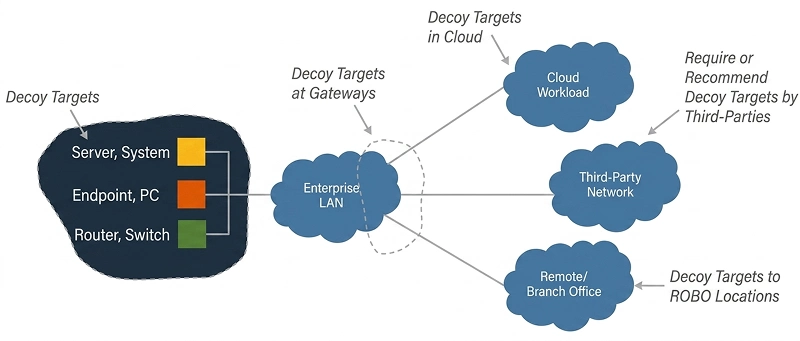
In hybrid infrastructures, this discovery process also maps connections between cloud resources and on-premises systems, helping security teams identify potential lateral movement paths across the environment.
2. Deployment of Realistic Cloud Decoys
New deception platforms strategically deploy realistic decoys in cloud and hybrid environments to tempt the attacker in the stages of reconnaissance and lateral movement. These decoys can be fake AWS EC2 instances, bogus Azure storage repositories, fake Kubernetes pods, or simulated cloud administrator accounts that resemble real resources. Assessing these assets in areas where attackers are likely to look will establish detection points throughout the environment.
The deception platform instantly generates alerts when attackers engage in these decoys, enabling security teams to detect malicious activity at an early stage.
3. Breadcrumbs and Fake Credentials
Breadcrumbs and planted credentials are another important point of cloud deception. Attackers commonly search for sensitive API keys, access tokens, SSH credentials, and cloud configuration files during reconnaissance and credential theft activities. Deception platforms are intentionally deployed with fake credentials where attackers are likely to find them. The attackers can use these credentials to access cloud resources, and the security team is immediately notified.
4. Real-Time Threat Monitoring & Visibility
Deception technology’s monitoring features are particularly potent because they provide real-time insight into attackers’ behavior. Security analysts can watch to see how attackers are moving around, what resources they are attacking, the credentials they are attempting to use, or if they are attempting to move laterally or to escalate privileges.
This visibility becomes especially important in hybrid environments where attackers may attempt to move between cloud workloads, user endpoints, identity systems, and on-premises infrastructure. This is because it offers valuable intelligence, which can help organizations react in advance of any actual systems to compromise.
5. Automated Incident Response Integration
Modern deceptions also can be integrated with SIEM, XDR, and SOAR platforms to automatically respond to deceptions. The platform can automatically isolate endpoints, block sessions, revoke credentials, or trigger incident response workflows in case of suspicious activity. This decreases the dwell time of an attacker and the potential damage that can be inflicted.
Impact on visibility, control, and compliance
Key challenges across enterprise and government environments
How to choose the right deployment strategy
Benefits of Deception for Cloud and Hybrid Security
Early Threat Detection
Early Threat Detection is one of the most significant benefits of the deception of technology. It is common for attackers to conduct a lengthy Recon / Cred discovery before carrying out destructive activities. These early stages are critical to identification of malicious activity by deception systems, which can allow defenders to act before attackers reach critical systems.
Reduced False Positives
One of the other key advantages is the decrease in false positives. Deception alerts are much more effective because legitimate users do not interact with deceptive assets.
Enhanced visibility of devices across hybrid environments.
Deception technology improves visibility across hybrid infrastructures by monitoring attacker activity across cloud workloads, endpoints, containers, identities, and on-premises systems. This helps security teams track attacker movement across interconnected environments more effectively.
Enhanced incident response and Zero Trust support
The intelligence collected via deception technology enhances the entire incident of action and security models by bringing active detection capabilities across the environment.
Fidelis Deception for Cloud and Hybrid Environments
Fidelis Security provides advanced deception capabilities to inform organizations about the early stages of attack, in cloud and hybrid environments. Fidelis Deception® features realistic decoys, credentials, breadcrumbs and cloud assets to replicate production workloads, storage, containers, endpoints, and identity services on AWS, Azure, Kubernetes, and on-premises infrastructure.
These types of deceptive assets can be deployed throughout the environment to identify reconnaissance, credential theft, privilege escalation, and lateral movement prior to reaching critical systems. It also continuously identifies and tracks changes in infrastructure to ensure coverage adapts to dynamic cloud environments.
High fidelity detection and wide ecosystem integration make Fidelis Deception® a valuable addition to hybrid security operations. The platform also creates fake API keys, access tokens, cloud credentials, and other misleading artifacts that result in alerts with very few false positive rates as legitimate users are less likely to interact with the platform.
Security teams have real-time visibility into attacker actions, and integration with SIEM, XDR, SOAR, and incident response platforms allow for automated response actions like endpoint isolation, credential revocation and workflow orchestration. It brings a realistic deception, automation and hybrid coverage to increase threat visibility, rapid detection, and enhance cloud security operations.
Conclusion
Deception-based threat detection is a proactive cybersecurity solution tailored to today’s cloud and hybrid environment. Using realistic decoys, fake credentials, misleading workloads and clever breadcrumbs throughout distributed environments, organizations can identify attackers when they are trying to find their way into the environment and as they are moving laterally in the system before they cause any real harm.
Cloud deception technologies will be increasingly important as the adoption of clouds grows, enabling organizations to gain better visibility, quicker detection, and longer time before attackers exploit them. Advanced deception platforms offer an extra layer of defense to organizations beyond what they can achieve with their baseline security tools to improve detection precision in complex hybrid environments.
Our customers detect post-breach attacks over 9x Faster
Detect Advanced Threats Before Damage Escalates TrustedCybersecurity Leader for 20+ YearsSee why security teams choose us over other solutionsRequest a DemoRead Datasheet
Frequently Asked Questions
How is Fidelis’s deception solution like cloud assets?
Fidelis Deception® simulates cloud assets and deploys very realistic decoys that simulate real cloud assets, user accounts, storage resources, credentials, containers, and services on cloud platforms. The decoys mimic the actions and characteristics of real assets and could be appealing targets for actors to engage in reconnaissance, credential theft, or lateral movement activities. The interactions result in high-confidence alerts, which assist security teams to identify threats early; since attackers have a hard time identifying decoys from assets, they are likely to detect them as well.
What kind of deceptions do you see being applied to cloud or hybrid environments?
The deception in the cloud and hybrid world involves the strategic placement of fake assets, credentials, breadcrumbs and workloads throughout cloud services, cloud endpoints, identities, and on-premises infrastructure. Today, deception platforms will automatically determine the environment, the locations of high-value assets, and the areas where the attackers will look to deploy their deceptions. Through this, unauthorized or malicious activities like reconnaissance, misuse of credentials, privilege escalation, and lateral movement inside distributed environments are detected.
Why is deception technology effective in hybrid cloud environments?
Cloud environments, on-premises systems, endpoints and identity platforms all exist together, resulting in more attack surface and visibility gaps. The gaps are bridged by deploying realistic decoys multiple times and places simultaneously, which is the essence of deception technology. Legitimate users are not likely to interact with deceptive assets, so high confidence alerts are provided to organizations, reducing the number of false positives, and providing better visibility of attacker activity across the entire infrastructure.
A hybrid deception architecture is a combination of two or more deception architectures.
A Hybrid Deception Architecture is a security solution that involves the integration of deception technologies in both cloud and on-premises resources to provide a single view of threats. It usually consists of decoy workloads, misleading credentials, mock cloud resources, fragments, and centralized monitoring coupled with SIEM, XDR, and incident response tools. This architecture allows companies to identify attacks across a distributed infrastructure consistently, and to respond and investigate them quickly.
Is it possible to use deception technology in AWS, Azure, and Kubernetes environments?
Yes. Modern deception platforms can deploy decoys in AWS, Azure, Kubernetes clusters, containers, virtual machines, or cloud storage services, all in multi-cloud and cloud-native environments. It enables organizations to track attacker activity across platforms and be visible in dynamic cloud environments.
Are false positive results created because of cloud deception?
There are low false positives with cloud deception, because legitimate users don’t engage in interaction with deceptive assets that often. Security teams are more likely to trust alerts because they are more likely to be genuine, as alerts are only generated when a user accesses fake credentials, fake workloads, fake storage buckets, etc.Typically, alerts are only sent when attackers interact with fake credentials, fake workloads, fake storage buckets, or other planted resources, and this increases the likelihood that the security team can trust them.
The post How does deception-based threat detection work in cloud and hybrid environments? appeared first on Fidelis Security.
No Responses