Key Takeaways
Cloud environments amplify false positives due to autoscaling, container churn, and constant configuration changes.
Legacy rule-based tools fire on routine events, overwhelming SOC teams and delaying real threat detection.
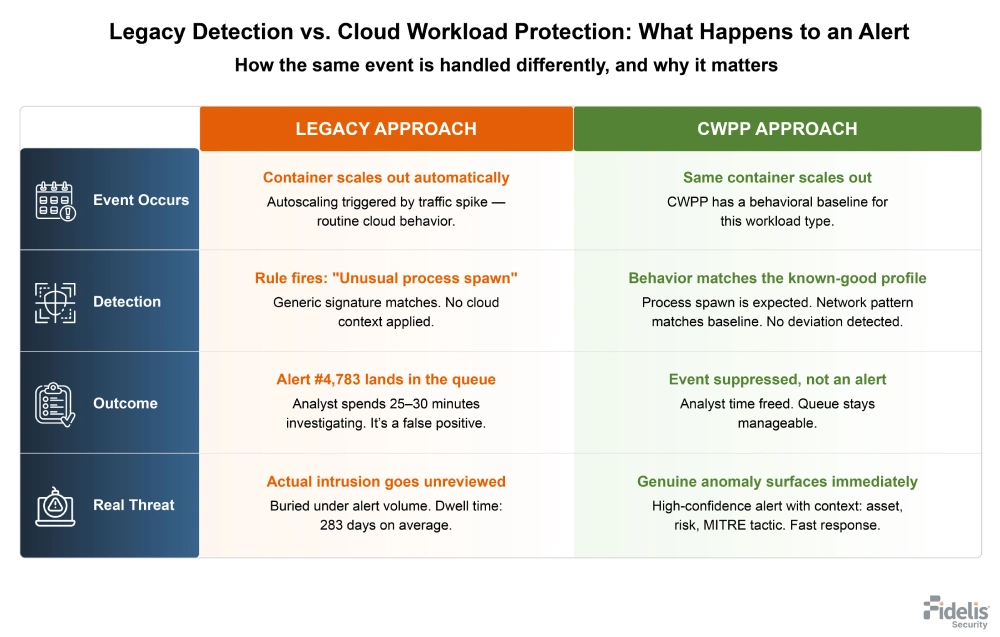
CWPPs reduce noise by baselining normal workload behavior and alerting only on meaningful deviations.
Runtime protection and exploitability-aware vulnerability prioritization cut unnecessary alerts.
Unified correlation and posture context transform raw signals into high-confidence, actionable security alerts.
Security teams in 2026 aren’t losing ground because attackers are smarter. They’re losing ground because the signal-to-noise problem has become unmanageable, and cloud environments are making it worse.
Every auto-scaling event, container restart, pipeline deployment, and configuration update generates telemetry. Legacy rule-based tools fire on all of it.
The result: a flood of alerts that buries the ones that actually matter.
That’s the false positive problem. And for organizations running workloads across public, private, or hybrid cloud environments, it’s not just an operational headache, it’s a direct security risk.
This article breaks down why false positives are uniquely worse in cloud environments, what cloud workload protection tools do differently, and the specific mechanisms that bring alert noise down without reducing detection coverage.
14.1 hrs
Average hours per week security teams spend chasing false positives
$4.88M
Global average cost of a data breach in 2024
66%
Of security teams can’t keep up with alert volumes
71%
Of organizations use 10+ separate cloud security tools
90%
Of SOCs overwhelmed by alert backlogs
Why False Positives Hit Harder in Cloud Environments
Cloud infrastructure wasn’t built for the security tools most teams are running on it. Those tools were designed for static, on-premises infrastructure, where servers stayed up, network baselines were stable, and “anomaly” meant something.
In cloud environments, the baseline shifts constantly. Containers spin up and die in seconds. Autoscaling events spike traffic. DevOps pipelines push deployments every few hours. Serverless functions execute briefly and disappear without a trace.
To a legacy rule-based detection system, a lot of that looks suspicious. And that’s where the false positive avalanche begins.
Key finding: According to the Check Point 2025 Cloud Security Report, 65% of organizations experienced a cloud security incident in the past year, yet only 9% detected it within the first hour, and only 6% could remediate within an hour. Alert fatigue is a direct contributor to those response delays.
Here are the specific dynamics that make cloud environments a false positive breeding ground:
Dynamic Infrastructure Breaks Static Baselines
Autoscaling, workload migration, and burst traffic all look like anomalies to tools built for predictable environments. Without cloud-native context, almost every scaling event becomes an alert.
Tool Sprawl Creates Duplicate Alerts
With 71% of organizations relying on 10+ cloud security tools, the same incident often triggers separate alerts across multiple platforms, each flagged independently with no deduplication in sight.
Generic Rules Don’t Understand Cloud Context
A rule that fires on any privilege escalation is useless in an environment where CI/CD pipelines legitimately escalate permissions as part of every deployment cycle.
Siloed Tools Miss the Full Picture
When network, endpoint, and cloud tools operate independently, a single incident can generate three separate alerts, each reviewed in isolation, tripling the analyst workload for one real event.
The financial consequences are clear. IBM’s 2024 Cost of a Data Breach Report1 found that breaches involving data stored across multiple cloud environments averaged $5.17 million, above the global average, and took 283 days to identify and contain. Extended dwell times are, in large part, a symptom of teams too buried in false alerts to act on the real ones.
What Makes a Cloud Workload Protection Platform Different?
A Cloud Workload Protection Platform (CWPP) is purpose-built to secure workloads where they actually run: virtual machines, containers, and serverless functions across public, private, and hybrid cloud environments.
Unlike security tools adapted for the cloud, a workload protection platform is designed from the ground up to understand cloud context. That design difference is what drives down false positive rates, not by reducing detection sensitivity, but by applying better intelligence before an alert is raised.
What separates CWPP from traditional security tools: Context. A CWPP understands what normal looks like for a specific workload, its expected processes, network behavior, file access patterns, and API calls. It flags deviations, not events. Traditional tools flag events, most of which are routine.
The Core Capabilities That Cut False Positives
Here’s how each key CWPP capability directly reduces alert noise:
CWPP CapabilityHow It Reduces False PositivesAlso Catches
Behavioral Baseline MonitoringLearns normal workload behavior; flags only statistically significant deviations, not every anomalyFileless attacks, lateral movement, insider threatsRuntime ProtectionEvaluates process execution in context; auto-scaling and pipeline tasks are recognized as expectedMemory-based exploits, malicious code injection, zero-daysContinuous Vulnerability AssessmentScores findings by exploitability, not just existence, cutting thousands of low-priority CVE alertsActively reachable vulnerabilities with real attack pathsFile Integrity Monitoring (Context-Aware)Suppresses FIM alerts within authorized change windows; flags unexpected modifications outside themUnauthorized file changes, tampered binaries, rootkitsCloud Security Posture Management (CSPM)Cross-references alert severity with actual configuration risk; reduces noise from overly broad policiesMisconfigurations, IAM drift, compliance violationsUnified Platform CorrelationMerges network, endpoint, and cloud signals into single incidents, eliminates duplicate alerts at the sourceMulti-vector attacks that span cloud and on-prem infrastructureAPI Security ControlsBaselines expected API call patterns; suppresses known-good traffic, flags deviationsAPI abuse, unauthorized data exfiltration, supply chain attacks
A Closer Look: How Each Mechanism Works
1. Behavioral Baselines Replace Rigid Rules
This is the foundational shift. Rule-based detection fires when an event matches a pattern. Behavioral detection fires when behavior deviates from the established norm for that specific workload.
A CWPP observes what’s normal, which processes run, what network connections are made, which files are accessed, and how system resources are used. When it sees a meaningful deviation from that baseline, it alerts. Routine events, no matter how unusual they look to a generic rule, don’t become alerts if they’re consistent with the workload’s known behavior.
This distinction alone accounts for a significant portion of false positive reduction in cloud security tools.
2. Runtime Protection Tied to Workload State
Many threats, fileless malware, process injection, memory exploits, only appear at execution time. Static scans can’t catch them. Runtime protection monitors workloads as they execute, and because it understands the workload’s expected execution profile, it can precisely separate a genuine exploit from a scheduled cron job or a CI/CD pipeline task.
Runtime protection anchors detection to behavior in the moment, not to a static signature database that grows outdated. This reduces both false positives and the missed detections that occur when signatures lag behind emerging threats.
3. Vulnerability Assessment That Accounts for Exploitability
Legacy scanners report every CVE they find. In a modern cloud environment, that can mean tens of thousands of findings, many for vulnerabilities in code paths that are never executed, or that existing security controls already block.
A CWPP with continuous vulnerability assessment goes further. It evaluates whether a vulnerability is actually reachable and exploitable in your environment, given real-world configuration and runtime context. Findings that are blocked by existing access controls or confined to unused code paths are de-prioritized. What remains is a short list of genuinely exploitable vulnerabilities, not a dump of every CVE that exists anywhere in the stack.
4. Context-Aware File Integrity Monitoring
Naive FIM tools are notorious for noise. Every software update, patch, log rotation, and config change triggers an alert. A cloud-aware CWPP integrates FIM with change management context, it knows when a deployment is happening, when patches are expected, and when maintenance windows are active.
Changes within authorized windows are treated differently from unexpected file modifications at 2am on a Tuesday. This context-based filtering dramatically reduces FIM alert volume without any reduction in detection coverage for actual tampering.
5. CSPM Adds Configuration Context to Runtime Alerts
Cloud security posture management continuously checks configurations against security best practices and compliance frameworks. When integrated into a unified workload protection platform, CSPM enriches runtime alerts with an important question: is this workload hardened, or is it already misconfigured?
A suspicious event on a fully hardened, properly configured workload carries different risk weight than the same event on a workload with open ports, excessive IAM permissions, and publicly exposed storage. CSPM-enriched alerts reflect actual risk, not just technical pattern matches, which directly reduces the false positive rate.
6. Unified Platform Correlation Kills Duplicate Alerts
According to Ponemon research, the average enterprise SOC now costs $5.3 million annually, up 20% in a single year. A significant part of that cost is analyst time spent reviewing the same incident from three or four separate tools that don’t talk to each other.
A unified cloud security solution that consolidates CWPP, CSPM, network detection, and endpoint telemetry automatically correlates signals across layers. What would have been four separate alerts becomes one high-confidence incident with full context, dramatically reducing alert volume while improving investigation quality.
See how Fidelis Halo applies workload intelligence to cut false positives at the source.
Unified CWPP + CSPM
Runtime workload monitoring
Risk-based CVE prioritization
Context-aware alerting
CWPP vs. Traditional Security Tools: Side-by-Side
The table below compares how traditional security tools and a purpose-built CWPP handle the key factors that drive false positives in cloud environments.
FactorTraditional ToolsCloud Workload Protection Platform
Detection methodSignature/rule-based, fires on patternsBehavioral, fires on meaningful deviation from workload baselineCloud context awarenessNone, can’t distinguish autoscaling from attackNative, understands cloud-native behavior patternsAlert correlationSiloed, same event creates multiple independent alertsUnified, correlates signals into single, contextualized incidentsVulnerability prioritizationReports all CVEs regardless of exploitabilityFilters by reachability and exploitability in real environmentFIM noise filteringFires on every change, updates, patches, logsRespects authorized change windows; alerts only on unexpected changesPosture integrationSeparate CSPM tool with no runtime linkCSPM-enriched alerts reflect actual configuration riskMulti-cloud supportOften limited to single cloud providerSpans AWS, Azure, GCP, and on-premises from a single platformRuntime threat detectionStatic scans only, misses runtime and fileless attacksMonitors live execution; catches in-memory and fileless threats
How to Actually Reduce False Positives With CWPP: Practical Steps
Choosing the right platform matters. But so does how you use it. Security teams that implement CWPPs without proper tuning often replicate the same noise problem with better tooling. Here’s what actually works:
Tune detection policies to your specific workloads.
Generic out-of-the-box policies generate generic noise. Invest in mapping detection policies to the actual expected behavior of each workload type, containers, serverless functions, VMs, in your specific environment before enabling automated response.
Build behavioral baselines before acting on alerts.
Give your CWPP adequate observation time, typically two to four weeks, to learn normal workload behavior. Acting on alerts before baselines are mature amplifies false positives during the critical initial phase.
Shift security left into the software development lifecycle.
Catching misconfigurations and vulnerabilities in CI/CD pipelines before workloads reach production means fewer anomalous configuration states at runtime, which directly reduces the alert surface.
Consolidate tools to eliminate duplicate alert sources.
If your cloud security stack generates alerts from five or more separate tools for the same event type, you have a duplication problem. Consolidating CWPP, CSPM, and network detection into a unified platform eliminates duplicate alerts at the source.
Use exploitability context to manage vulnerability alerts.
Filter vulnerability findings by reachability and actual risk in your environment. Don’t treat every CVE as equally urgent, the ones blocked by existing access controls are not today’s problem.
Integrate CWPP alerts with MITRE ATT&CK mapping.
Alerts tagged to specific MITRE tactics and techniques give analysts immediate investigative context and allow teams to prioritize based on attack-stage criticality rather than raw severity scores.
Enable access management baselines for identity-layer detection.
Tracking which identities access which resources, from where, and at what times gives the CWPP the context to distinguish authorized automation from suspicious access, a major source of false positive reduction in IAM-heavy environments.
Key finding: IBM’s 2024 research found that organizations using AI and automation extensively in prevention workflows saw an average $2.2 million reduction in breach costs compared to those that didn’t.
How Fidelis Security Reduces False Positives in Cloud Workload Protection
Fidelis Halo® reduces alert fatigue by applying cloud-native workload intelligence before an alert is generated, not after.
Here’s how:
Unified CWPP + CSPM Architecture
Fidelis Halo® combines cloud workload protection and cloud security posture management in a single CNAPP platform across AWS, Azure, and GCP. This allows runtime activity to be evaluated alongside configuration risk, reducing context-blind alerts.
Lightweight Microagent Monitoring
Fidelis Halo® deploys a patented microagent (~2MB footprint) to continuously monitor processes, file activity, and system behavior without degrading workload performance. Continuous visibility enables more accurate runtime detection in dynamic cloud environments.
Runtime Workload Protection
Instead of relying only on static scans, Fidelis Halo® monitors live workload activity, providing execution-time visibility into processes and system changes, critical for distinguishing expected automation from suspicious behavior.
Continuous Vulnerability Assessment with Risk Prioritization
Fidelis Halo® performs ongoing vulnerability assessment and applies contextual, risk-based prioritization, helping teams focus on higher-risk findings instead of treating every CVE equally.
Policy-Based File Integrity Monitoring
File integrity monitoring (FIM) tracks changes to critical system files and configurations with policy-driven controls, reducing unnecessary alerts while maintaining visibility into unauthorized modification.
Contextual Alerting and Prioritization
Fidelis Halo® provides contextual alerting tied to asset risk and configuration state, helping security teams prioritize meaningful findings and reduce alert fatigue.
The Real Cost of False Positive Overload and What to Do About It
False positives aren’t just annoying. They’re dangerous. A 2025 survey of 1,150 cybersecurity leaders by Illumio found that security teams spend an average of 14.1 hours per week chasing false positives — time pulled directly away from investigating real threats. The SANS 2025 SOC Survey3 found that 66% of teams can’t keep pace with incoming alert volumes. And Osterman Research found that nearly 83% of analysts are overwhelmed by alert volume, false positives, and lack of alert context.
When analysts are buried in noise, real threats extend their dwell time. The Verizon 2025 DBIR2 analyzed over 22,000 security incidents and found that credential abuse and vulnerability exploitation remain the dominant initial attack vectors, the kinds of threats that a well-tuned detection environment should catch early.
Cloud workload protection tools address this problem where it starts: at the detection layer. By building behavioral baselines for each workload, applying exploitability context to vulnerability findings, correlating signals across platforms, and filtering alerts with cloud-native intelligence, CWPPs produce something that generic security tools rarely achieve, alerts that security teams can actually trust.
That trust is the foundation of a responsive security operation. When analysts know that a high-severity alert from their CWPP reflects a real, contextualized risk, they act on it. When they don’t trust the signal, they wait, and attackers use that time.
The goal isn’t fewer alerts for its own sake. It’s alerts that reflect real risk, carry enough context to act on immediately, and surface the threats that actually need a security team’s attention, before they become incidents.
Citations:
The post How Cloud Workload Protection Tools Help Reduce False Positive Alerts appeared first on Fidelis Security.
No Responses