Key Takeaways
Double extortion ransomware combines data encryption with data theft, increasing pressure on organizations by threatening both operational disruption and public data exposure.
Attackers gain access through phishing, weak credentials, or unpatched vulnerabilities, then move laterally to exfiltrate sensitive data before encrypting systems.
A Zero Trust approach, strong IAM practices, and data classification are critical to limiting attacker movement and protecting high-value assets.
Advanced security measures like EDR/XDR, DLP, immutable backups, and continuous monitoring help detect, prevent, and respond to attacks effectively.
Proactive security, employee awareness, and a well-tested incident response plan are essential to minimize damage, recover quickly, and protect business reputation.
The changing cyber threat landscape has made data protection a top priority for organizations facing increasingly sophisticated ransomware attacks, especially double extortion of ransomware. Unlike traditional ransomware, modern attackers not only encrypt critical data but also steal sensitive information to increase pressure on victims and amplify operational, financial, and reputational damage.
In fact, recent research shows that 96%1 of ransomware incidents now involve data theft alongside encryption, highlighting the rapid rise of double extortion tactics.
What Does Double Extortion Ransomware Actually Mean?
The ransomware that involves double extortion is a form of cyberattack where the attackers not only encrypt your data but also steal it. When they get access to a system, they steal sensitive data silently and close files. Then they require money to have access to it again and threaten to publish the stolen information unless the ransom money is paid.
This is a dual pressure attack that is much more harmful than conventional ransomware. Although an organization may have backups and restore its systems, the probability of exposing the data to the people is still there.
How Double Extortion Ransomware Attacks Work
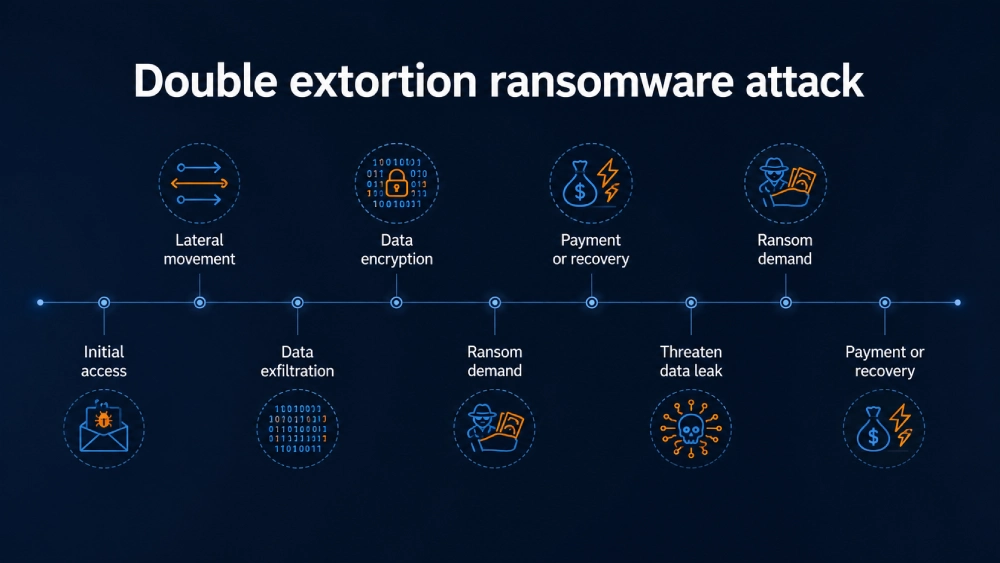
A ransomware attack, which is a double extortion, is commonly initiated with a preliminary compromise. Hackers usually get in via phishing emails, poorly secured passwords, or unpatched vulnerabilities. When they get in, they scan the network in a lateral way, detecting sensitive systems and data of high importance.
They steal sensitive information by extracting the same before initiating the encryption process and sending the information to other servers. It is only after this that they install ransomware to encrypt files and break down the operations. Lastly, they send a ransom and threaten the loss of data and exposure in general. Such organized methods render these attacks very efficient and hard to counter once they have been successfully implemented.
Double Extortion Ransomware Example
Several high-profile cases of double extortion ransomware attacks have proved that this strategy can be very devastating. Other initial ransomware organizations such as Maze were the first to use the tactic of dumping stolen information on leak sites. Subsequently, other groups like REvil and Darkside further improved the model and focused on large organizations and critical infrastructure. These cases revealed that the actual harm is not necessarily only at the time of operational interruptions but also a loss of reputation, legal ramifications, and loss of customer trust.
Defense Against Ransomware
Emerging Ransomware Trends
MITRE ATT&CK
Tactics and Techniques
Unique Tactics Across Platforms
Building a Strong Double Extortion Ransomware Defense
A successful defense of ransomware with double extortion should be a layered, proactive design with a combination of technology, processes, and human awareness. Organizations need to create various layers of defense, which interact to avert, identify, and react to attacks, instead of using one security tool. Here are ten extended policies to enhance your security stance against double extortion of ransomware attacks.
1. Adopt a Zero Trust Security Model
The current day cybersecurity is based on Zero Trust. It is since no user, device, or system should be trusted by default even when it is within the network. All access requests should be constantly verified based on identity, the health of a device, and behavior. Through the least-privilege access and micro-segmentation, organizations can limit an attacker with regard to the distance he or she can go through the network. Lateral movement is greatly limited by Zero Trust, even when hackers have been able to access a network with initial access, and the possibility of massive data exfiltration is minimized.
2. Strengthen Identity and Access Management (IAM)
Compromised credentials are one of the most common entry points for attackers. Strengthening identity and access controls is critical to reducing this risk. Organizations should enforce multi-factor authentication across all systems, especially privileged accounts. Strong password policies, single sign-on solutions, and privileged access management tools further enhance security. Continuous monitoring of login behavior can also help detect suspicious activity early.
3. Prioritize Data Protection and Classification
Because the main aim of the double extortion of ransomware is to steal data, the organization must be aware of the location of their sensitive data. The process of data classification assists in recognizing vital assets like customer data, financial data, and intellectual property. After this information is classified, encryption, high access controls and monitoring should be applied. This makes sure that in case attackers have gained access to systems, the best data would be hard to use.
4. Implement Data Loss Prevention (DLP) and Monitoring
One of the most important steps in the ransomware tactics of doubling extortion is data exfiltration. Data Loss Prevention applications assist in tracking and managing the access, sharing, and transfer of data. DLP systems are also able to identify abnormal patterns through network traffic and user activity, including large data transfers and unauthorized uploads. Live warnings and automatic reactions will be able to prevent data theft before it turns into a complete security breach.
5. Maintain Secure, Isolated, and Immutable Backups
Backups are still needed to make recovery even though they do not stop the leakage of data. The organizations are advised to have offline or air-gapped backups that are totally detached to the main network. Immutable storage is used to make sure that attackers can neither modify nor delete back-up data. The testing of backup systems should also be performed on a regular basis to ensure that recovery operations are effective in case of an incident.
6. Keep Systems Patched and Manage Vulnerabilities
Software which has not been patched and systems that are out of date are major targets of attackers. An effective vulnerability management program will make sure that vulnerabilities are pointed out and dealt with in good time. Patching of operating systems, applications, and firmware on a regular basis will minimize the attack surface. Patch management tools can be automated to enable organizations to remain current without causing disruption of operations.
7. Deploy Advanced Endpoint and Network Detection Tools
The current threats demand the use of sophisticated detection. Extended Detection and Response (XDR) and Endpoint Detection and Response (EDR) solutions will provide real-time visibility of activities at the endpoint and network. These tools rely on behavioral analysis and threat intelligence to detect suspicious activity including strange file encryption and unauthorized access attempts. Early warning enables the security personnel to react before the attackers can accomplish the goal.
8. Conduct Regular Security Awareness Training
Employees are best placed to be the first to be on the frontlines- and in other cases, the frontline. Social engineering attacks and phishing emails are still very effective ways of accessing them. Conducting regular training sessions can assist the employees in identifying threats, preventing dangerous actions, and reporting efficiently. Awareness and enhanced response preparedness can also be reinforced by using simulated phishing exercises that are cut across the organization.
9. Develop and Test an Incident Response Plan
None of the organizations are fully resistant to cyberattacks. An incident response plan is prepared and therefore the response is fast and organized in case an attack takes place. The plan ought to stipulate positions, communication measures, containment measures, and recovery measures. Tabletop exercises and regularly drilled scenarios assist teams in playing out real life scenarios and limiting the confusion and downtime in the case of a real attack.
10. Leverage Threat Intelligence and Proactive Monitoring
It is highly necessary to have proactive security measures in countering emerging threats such as the use of double and triple extortion of ransomware. Threat intelligence informs about the actions of attackers, the vulnerabilities that arise, and the new methods of attack. Through the implementation of threat intelligence into security systems organizations can foresee attack and protect themselves beforehand. Monitoring and threat hunting continuously go more to the extent of ensuring potential threats are discovered and reduced before they bring any harm.
With these ten strategies, organizations, under the implementation, can have a robust and round-trip of ransomware defense. It is not only about avoiding attacks but also reducing their effects and fast recovery – not only crucial data but also a long-term reputation.
Enterprise Ransomware Protection Strategy
In the case of larger organizations, protection of enterprise ransomware needs not to be limited to basic security controls. It must incorporate several levels of defense at endpoints, networks, and cloud environments. It involves the adoption of Zero Trust architecture, centralized monitoring systems, and threat intelligence. Automation is also significant in responding to threats in time, and the amount of time attackers can stay unnoticed. A company-wide approach can be used to make sure that security is uniform and scalable to all systems and users.
The Importance of Proactive Security
Current cybersecurity demands a change in approach between reaction and proactive protection. Organizations have to keep their environments under round-the-clock observation, detect their vulnerabilities, and mitigate them before the attackers can exploit these vulnerabilities. The implementation of proactive controls like threat hunting, periodic auditing, and automated detection systems is a major step towards minimizing the chances of a successful attack. This is necessary in countering more sophisticated attacks such as double extortion of ransomware attacks.
Should Organizations Pay the Ransom?
This is a short-term solution that is associated with a lot of risks such as paying for the ransom. Attackers will not necessarily restore access or avoid leakage of data. In most instances, even a reward will only encourage them to attack more and finance the activities of cybercriminals. Companies ought to instead aim at prevention, resilience, and recovery efforts, which decrease reliance on attackers.
Final Thoughts
Ransomware defense based on double extortion is no longer an option anymore: it is an essential component of contemporary cybersecurity. Due to the sophistication of the attackers working towards the second and third waves of extortion ransom, companies will need to be proactive and comprehensive. The combination of robust access controls, data protection, active monitoring, and awareness of employees is the most efficient strategy. Investing in these spheres, businesses will be able to secure their data, retain the trust of their customers, and preserve their reputation in the rapidly growing hostile digital environment.
Citations
The post How to Defend Against Double Extortion Ransomware: Protecting Your Data and Your Reputation appeared first on Fidelis Security.
No Responses