Key Takeaways
Most cloud breaches now occur at the workload level, making runtime protection essential
Pre-deployment scans miss live threats inside running workloads
Gaps across VMs, containers, and serverless create real security blind spots
Agent and agentless approaches impact both coverage and visibility depth
Multi-cloud environments require unified visibility to avoid fragmented detection
Continuous compliance is necessary due to constant configuration drift
Faster instrumentation reduces exposure during scaling
Real validation matters more than vendor feature claims
Every cloud workload protection platform vendor claims runtime protection, multi-cloud support, and compliance automation. The feature lists look identical. The gaps between what is claimed and what is delivered only surface after deployment, when switching costs are high. This guide answers one question directly: what should a buyer actually verify before choosing a CWPP solution? Each section is a buying criterion. Every section ends with what to specifically test or ask.
1. Does It Actually Deliver Runtime Protection, or Just Pre-Deployment Scanning?
This is the single most important criterion in evaluating any cloud workload protection platform, and the most commonly misrepresented. Pre-deployment image scanning finds vulnerabilities in a container image before it ships. That is necessary. It is not runtime protection.
Runtime protection monitors cloud workloads while they execute, tracking system calls, process behavior, file writes, and network connections inside live workloads. It detects threats that are invisible to pre-deployment scanners: a CVE published hours after your container started running, a configuration change made overnight, an attacker moving laterally through cloud based workloads after a credential theft, or a crypto-miner injected through a supply chain compromise. These are the runtime threats that cause real security incidents, and no pre-deployment tool catches them.
This is where runtime-focused platforms differentiate. Fidelis CloudPassage Halo® provides visibility into running workloads along with vulnerability management and file integrity monitoring, helping security teams identify changes and risks that emerge after deployment rather than only at build time.
What eBPF-Based Detection Means for Cloud Workload Security
The current standard for deep visibility into modern cloud workloads is eBPF (extended Berkeley Packet Filter). It operates at the kernel level, intercepts system calls, and provides process-level observability with minimal performance overhead and no code changes to the workload. It blocks potential threats inline before they execute, rather than detecting them after the fact. Platforms using traditional agent approaches or API-level monitoring operate with significantly less depth and cannot provide real time threat detection at the process level.
Ask: Do you use eBPF? At what scope: process, network, or file system? Can you demonstrate a live runtime threat detection event in a test environment that matches our workload types? Recorded walkthroughs are not acceptable for this test.
2. Which Workload Types Does It Cover, and How Deeply?
A workload protection platform (CWPP) that covers virtual machines but not containers, or containers but not serverless functions, has a coverage gap that only surfaces in production. Modern cloud environments run four distinct workload types. Each requires a different security approach. Verify each separately before choosing a CWPP solution.
Workload TypeWhy It Needs Its Own Security ApproachWhat to Ask the Vendor
Virtual MachinesLong-lived workloads that accumulate unpatched vulnerabilities quietly. A misconfigured IAM policy or outdated OS package can sit undetected through multiple compliance cycles.Is vulnerability scanning continuous or scheduled? Does it correlate CVE severity with actual internet exposure and reachability from other cloud workloads?ContainersSpin up and down in seconds. Scheduled scans miss most of what is running at any given moment. Image scanning before deployment does not equal runtime monitoring of live containers.Do you monitor container behavior after deployment, including process trees, network connections, and file writes, and not just the image before deployment?Kubernetes ClustersOverprivileged service accounts, misconfigured admission controllers, and RBAC gaps in Kubernetes create security risks that affect every workload in the cluster simultaneously.Do you enforce security policies at the Kubernetes admission layer? Do you monitor API server activity for anomalous calls that could indicate compromise?Serverless FunctionsNo OS layer. Standard agents cannot deploy into managed execution environments. Google Cloud Platform Functions, AWS Lambda, and Azure Functions all require dedicated execution hooks.How do you protect serverless functions at execution time? What execution hooks do you use, and what specifically do they monitor about function behavior?
Ask for a technical demonstration of protection for each workload type in your environment separately. A platform with strong coverage for virtual machines may have shallow or absent serverless protection. Confirm each type independently.
3. Agent-Based or Agentless: Which Does It Support, and Does It Matter?
The choice between agent-based and agentless CWPP has direct consequences for coverage depth and operational overhead in cloud environments. Vendors strong on one approach will downplay the tradeoffs of the other. Understanding both is essential for any security management evaluation.
Agent-Based: Deep Visibility, Deployment Overhead
What you get: Process-level visibility inside the workload: system calls, file access, network connections, and memory behavior. Strong for long-running virtual machines and servers where deployment overhead is justified by depth of visibility.
The gap: Any workload that provisions before the agent deploys has zero coverage during that window. In public cloud environments that scale dynamically under load, which describes every production cloud environment, this happens constantly. The window is an unprotected exposure.
Agentless: Immediate Breadth, Shallower Depth
What you get: Immediate coverage across cloud based applications and workloads through cloud provider APIs and snapshot analysis. Nothing to install or manage on individual workloads. Ideal for ephemeral containers and read-only workloads across multiple cloud providers.
The gap: API-level visibility shows what the cloud provider surfaces, not what is executing at the process level inside the workload. You see configuration state, not live process behavior. For detecting runtime threats, agentless coverage alone is insufficient.
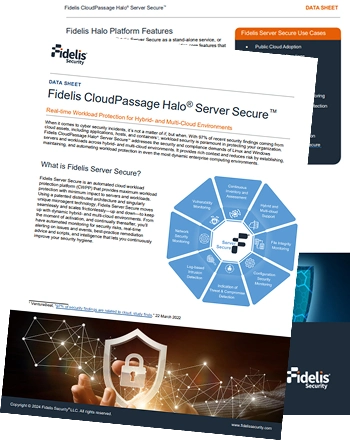
Platforms that combine both models close that gap more effectively. Fidelis Security CloudPassage Halo Server Secure® uses agent-based controls for workload-level visibility, including vulnerability management and file integrity monitoring, alongside agentless cloud configuration assessment, so coverage does not depend on a single approach.
Ask: What happens to a workload that provisions before an agent is deployed? What is the coverage gap window? Do you support both agent-based and agentless simultaneously in the same environment, and if so, how does each layer complement the other?
4. The 10 CWPP Features That Matter and How to Validate Them
Before looking at feature lists, one clarification matters.
Many vendors bundle CWPP into broader CNAPP platforms that also include CSPM and container security. When evaluating solutions, assess CWPP capabilities separately. A CNAPP label does not guarantee strong runtime protection, and CSPM alone does not cover workload-level threats.
Once the scope is clear, the next step is evaluating features.
These are the features every CWPP vendor claims. The table below shows what to actually verify for each one, not what is promised, but what must be proven in a real environment before purchase.
FeatureWhat to Verify
Runtime ProtectionMonitors live cloud workloads in real time: system calls, process trees, network connections, and file writes.
Ask: do you use eBPF? At what scope (process, network, file system)? Get the technical answer, not the product slide. Real-time threat detection at the workload level is the standard.Vulnerability Scanning and ManagementContinuously scans virtual machines, container images, and application dependencies for CVEs. Prioritisation must reflect exploitability in your specific environment, not CVSS score alone. A critical CVE in a library unreachable from the internet is lower priority than a medium CVE on an exposed public endpoint.Cloud Security Posture ManagementMisconfigured IAM policies, exposed storage buckets, and open network security groups are the most common root cause of cloud breaches. A CWPP with built-in cloud security posture management correlates infrastructure configuration issues directly with workload risk, giving security teams one correlated view instead of two separate alert streams.Container and Serverless SecurityContainers and serverless functions require separate protection approaches. Containers need continuous runtime monitoring, not just image scans. Serverless functions such as AWS Lambda, Azure Functions, and Google Cloud Platform Functions have no OS layer. Standard agents cannot reach them.
Ask specifically: how do you protect serverless workloads at execution time?Network Segmentation and MicrosegmentationLimits the attack surface after initial compromise by restricting lateral movement between workloads.
Ask: does microsegmentation apply inside Kubernetes clusters, or only at the perimeter? East-west traffic between pods is where attackers move once they gain access to cloud environments.Compliance Monitoring and EnforcementMust run continuously, not on a schedule. Cloud infrastructure drifts daily.
Ask: is compliance status updated in real time when cloud infrastructure configuration changes? Can the platform enforce security policies and auto-remediate drift, or does it only alert? What does the evidence artifact look like for an auditor?Access Management and IAM MonitoringCredential theft is the top initial access vector in attacks on cloud environments. The CWPP should continuously detect overprivileged accounts, permission drift, and identity anomalies, then correlate IAM context with workload behavior to surface lateral movement paths before security incidents escalate.Unified Visibility Across Cloud ProvidersSecurity policies on AWS do not carry to Azure automatically.
Ask: can you show all cloud providers, including private and public clouds, in one interface using our actual provider mix? If the demo requires a sandbox environment, that signals something about real-world coverage depth.Advanced Threat DetectionMachine learning and behavioral analysis detect what signature-based tools miss: fileless malware, crypto-miners, container escapes, and privilege escalation.
Ask: what is the actionable-alert-to-total-alert ratio in a typical enterprise deployment? Get this from a customer reference, not a vendor estimate.Integration with Your Security StackThreat detection siloed inside the CWPP never reaches the security teams who act on it.
Ask: what are the native connectors to your SIEM and SOAR? How does a threat alert move from the platform into our incident response workflow, and how many manual steps does that require?
5. Does Multi-Cloud Visibility Actually Hold Up Under Testing?
Enterprises now use an average 2.1 public cloud providers. 55% say cloud security is more complex than on-premises, up from 51% the prior year.
Security policies enforced on AWS do not automatically carry to Azure. IAM configurations on Google Cloud Platform are not visible in your AWS Security Hub. A misconfiguration alert on Azure does not correlate automatically with related activity in an AWS Lambda function. Without genuine unified visibility across multi cloud environments, security teams investigate fragments of a single incident as separate events across separate security tools.
Micro-weight Cloud Workload Protection
Unified and Automated
Agile and Portable
What Comprehensive Visibility Across Cloud Providers Requires
One interface. All cloud service providers: AWS, Azure, Google Cloud Platform, private and public clouds, on-premises. Threat alerts that cross provider boundaries correlate automatically. Security teams see one incident with full context, not two disconnected alerts in two dashboards. Comprehensive visibility across the entire cloud network is not a UI wrapper around separate tools. It requires shared data models and cross-provider event correlation built into the platform architecture from the ground up.
This matters for enabling security teams to respond to potential security threats quickly. When a threat event in an Azure container correlates automatically to related network activity in an AWS workload, your team sees one incident. Without it, they see two unrelated alerts and may never connect them.
Ask: Request a live walkthrough using your actual provider mix, not a preconfigured sandbox. Ask whether private cloud appears in the same interface as public cloud infrastructure. Ask whether a threat alert in one cloud provider automatically surfaces correlated activity in another without any manual steps.
6. Is the Compliance Monitoring Continuous, or Just Periodic Reporting?
Most cloud workload protection platforms claim compliance monitoring. What they deliver ranges from fully continuous automated compliance enforcement to a quarterly report assembled before each audit. The difference matters enormously for security teams in regulated industries and for maintaining an accurate security posture.
Continuous Monitoring vs. Point-in-Time Scans
Cloud infrastructure drifts constantly. A workload that passed a PCI DSS check on Monday can drift out of compliance status by Wednesday when a developer changes a configuration or a new workload deploys without required controls. Point-in-time scans show compliance status at scan time only. In dynamic cloud environments where configurations change continuously, that data is stale before it reaches the team reviewing it.
Continuous monitoring detects cloud infrastructure configuration drift the moment it occurs and either auto-remediates to the correct state or triggers an immediate alert. That is the standard any serious workload protection platform CWPP should meet.
Evidence Artifacts vs. Dashboard Summaries
Auditors do not accept dashboard screenshots. They require signed records of specific control states at specific timestamps, tied to the actual cloud infrastructure configuration being assessed. Enforcing security policies must produce audit-ready evidence, not visual summaries. Ask to see the document that would go to your auditor, not the compliance dashboard.
Ask: Show me a real compliance evidence artifact from a current customer in our industry. Is it generated automatically and continuously, or assembled manually before audits? Which of our specific frameworks are covered at the control level: PCI DSS, HIPAA, GDPR, NIST 800-53?
7. How Fast Does It Instrument New Workloads, and What Does It Cost to Run?
Two operational factors get underweighted in feature-focused evaluations of cloud security platforms. Both have direct consequences at scale and directly affect your team’s ability to secure cloud workloads without operational friction.
Instrumentation Speed Is a Security Coverage Question
Cloud infrastructure scales constantly. During a traffic event, dozens of new instances appear in minutes. Every second between workload provisioning and instrumentation is an unprotected window where potential threats can establish a foothold. Anything over 90 seconds is a structural gap in dynamic public cloud infrastructure. Get a specific number from the vendor and verify it against a reference customer whose fleet scales dynamically under load, not a static test environment.
In practice, this comes down to how the platform is architected. Fidelis Security CloudPassage Halo® provides automated asset discovery and continuous monitoring across cloud environments, helping reduce visibility gaps as new workloads are introduced.
Operating Cost Beyond the License Fee
Some platforms use cloud computing snapshots to assess cloud based workloads. Snapshots consume compute resources and add cost to every assessment cycle. For large fleets, this adds a meaningful line to your cloud bill on top of the CWPP license. Architectures that offload security management processing to a dedicated grid run assessments without consuming workload compute budgets. For organisations actively managing cloud service costs, that architecture difference is financially significant.
Alert Quality Determines How Security Teams Actually Work
A security platform that generates hundreds of undifferentiated daily alerts creates analyst fatigue, not security. Platforms that correlate findings across workload behavior, threat intelligence, identity data, and network activity surface fewer, higher-confidence alerts, each carrying enough context to act on without a separate investigation. Automated threat detection with proper correlation is what enabling security teams to operate efficiently actually looks like in practice.
Ask: What is instrumentation time from workload provisioning to full coverage? Do you use cloud snapshots, and what is the cost at our projected fleet size? What is the actionable-alert-to-total-alert ratio in a current enterprise deployment? Get all three from a customer reference with a comparable environment, not from the vendor.
8. Nine Questions That Expose Real Gaps in Any CWPP Solution
These questions are designed to be difficult to answer with marketing language. Each targets a specific cloud workload security gap that frequently goes undetected until after deployment. Require specific, verifiable answers, and follow each with a customer reference.
Which workload types do you protect natively: virtual machines, containers, Kubernetes, and serverless functions, and what is the specific protection mechanism for each? “We cover all cloud workloads” is not an answer.
What is your runtime detection mechanism? eBPF, kernel module, API-based, or something else? What does each mechanism see at the process level inside running workloads?
What is the instrumentation time from workload provisioning to full security coverage? Get a number. Confirm it with a reference customer whose fleet scales dynamically under load.
What happens to a workload that provisions before an agent is deployed? This happens every time cloud infrastructure scales. How the platform handles that coverage window reveals its true agentless maturity.
Show me multi-cloud visibility using our actual provider mix in a live environment, not a sandbox. If a preconfigured environment is required, ask why that is necessary.
What is the actionable-alert-to-total-alert ratio in a comparable enterprise deployment? This number, from a real customer reference, tells you whether the platform produces security decisions or noise.
Do you use cloud snapshots for workload assessment, and what is the cost at our fleet size? Understand the full cost model: license, cloud compute consumed by the security layer, and any API or egress fees.
How does a threat alert move from your platform into our SIEM and incident response workflow? Count every manual step. Zero is the target for any production-grade security platform.
How to Make the Final Decision
Start with your environment, not vendor feature lists. Map your specific workload types, cloud service providers, compliance frameworks, and the operational constraints your security teams work under. Then measure every vendor against that map using the nine questions above.
Strong runtime protection for virtual machines does not automatically mean strong container and serverless functions coverage. Deep AWS support does not guarantee the same depth on Azure or Google Cloud Platform. Compliance monitoring that satisfies an internal audit may not satisfy an external PCI DSS assessor. Every gap in cloud workload protection is a gap in your security posture, and in modern cloud environments, gaps compound quickly. Every unprotected workload is a potential data security exposure waiting to be exploited.
The right cloud workload protection platform is the one that covers your specific workload types with verifiable runtime depth, gives your security teams unified visibility across all cloud environments, enforces security policies continuously, instruments new workloads fast enough to match your scaling speed, and integrates natively into your existing security tools. That is the standard. Hold every vendor to it.
The post What to Look for in a CWPP Solution appeared first on Fidelis Security.
No Responses