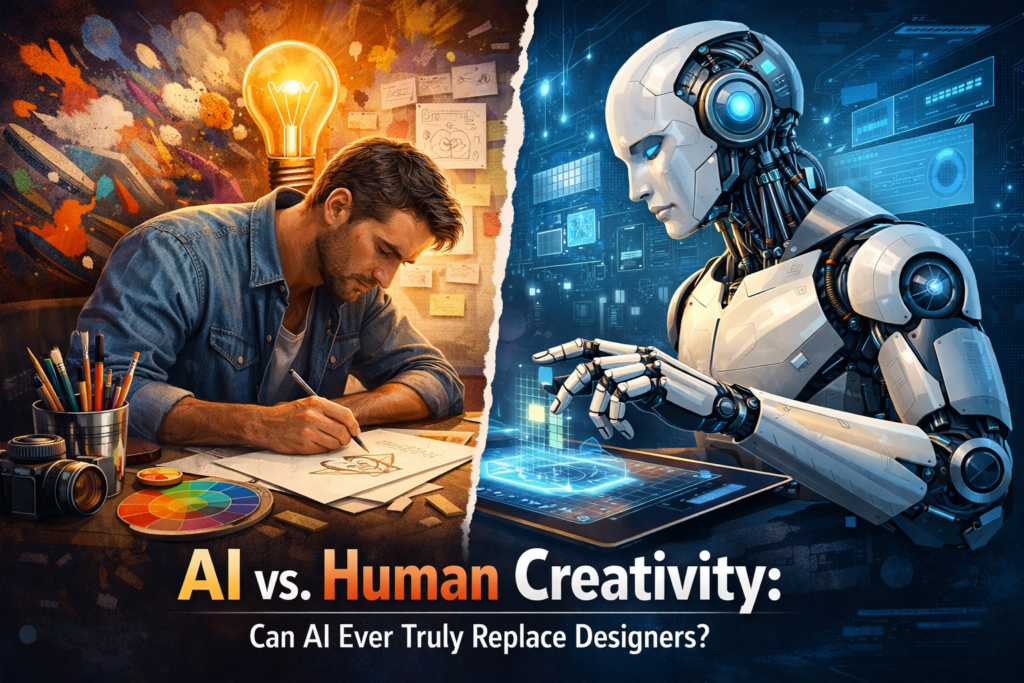
AI vs. human creativity is no longer a theoretical debate; it is a fundamental shift in how we define artistic labor. While algorithms can now generate hyper-realistic imagery in seconds, the tension in this field lies in the distinction between “making” and “meaning.” A machine can synthesize a million reference points, but it cannot feel the weight of a brand’s history or the nuance of a specific cultural moment.
To understand the future, we must realize that ai vs human creativity isn’t a zero-sum game. Instead, it is an evolution of tools. Just as the camera didn’t kill painting, but rather pushed it toward Impressionism, the rise of automated design is forcing creators to lean into what makes them uniquely human: emotional intelligence and intentionality.
1. Intentionality: The “Why” Behind the Design
One of the most significant differences in ai vs human creativity is the presence of intent. When a person designs, every line is a choice backed by a reason. In the digital spectrum, software lacks this “why.” It operates on probability, not purpose. Without a human to guide the prompt, the results may be technically perfect but conceptually hollow. Recent research from Swansea University (2026) highlights that AI is best utilized not as a quiet optimizer, but as a “creative collaborator” that encourages human exploration and engagement.
2. Emotional Resonance and Empathy
In the battle of ai vs human creativity, empathy is the human superpower. Effective design solves problems for people. Because machines have never felt joy, grief, or frustration, they cannot truly empathize with a user’s pain points. Humans remain superior because they design for visceral connection rather than just data optimization.
[Did You Know?]
According to the World Economic Forum (2026), as AI perfects the “average,” people will crave“human-ness” even more. This makes unpredictably human elements the ultimate differentiator for brands.
3. Cultural Context and Nuance
The gap in ai vs human creativity is widest when it comes to culture. AI is trained on historical data, which often contains biases. A human designer understands that a specific color might be celebratory in one culture but mournful in another. This dynamic proves that machines struggle with the subtle “unwritten rules” of society.
4. The Power of Originality
If you look at the landscape of innovation, AI is inherently derivative. It remixes what already exists. True “disruption” comes from thinkers who break the rules. Because algorithms rely on existing patterns, they will always struggle to invent a completely new aesthetic movement like Brutalism or Minimalism from scratch.
5. Strategy and Problem Solving
Design is more than just visuals; it’s strategy. In the ai vs human creativity debate, we see that software can’t sit in a boardroom and understand a client’s long-term business goals. While a tool can make a logo, only a professional can build a brand strategy that spans a decade.
6. Ethics and Moral Judgment
The ethics of automation are complex. Algorithms don’t understand copyright, consent, or social responsibility. As of 2026, the legal landscape remains clear: the U.S. Copyright Office continues to maintain that “human authorship” is the foundation of copyright protection, leaving purely AI-generated works in a precarious legal position.
7. The Collaboration Paradigm: Augmentation Over Replacement
The ultimate winner is the person who uses both. We are entering an era where ai vs human creativity is a partnership. By using technology to automate repetitive tasks—like resizing assets or generating ad variations—designers can focus on the “soul” of their work.
Comparison of Creative Capacities
FeatureHuman DesignersGenerative AIIntentional DesignSpeed of IterationEmotional NuanceScalability & ProductionCultural InsightPattern Discovery
Case Studies in the Industry
The real-world application of these tools proves that the best results come from synergy.
Adobe Firefly Integration: Adobe’s approach focuses on “Creator First.” Their tools emphasize a workflow where the software suggests, but the professional finalizes using commercially safe datasets.
Dentsu Research (2026): Their studies show that while 79% of CMOs worry about “brand sameness” driven by algorithms, 87% believe future strategies require deeper human creativity.
[Pro-Tip Box]
To master your workflow, don’t just prompt for a final product. Use technology to generate “what if” scenarios. This allows you to use the machine as a brainstorming partner rather than a replacement.
FAQ: Addressing Common Concerns
1. Is this technology a threat to entry-level jobs?
It is changing them. Tactical tasks like background removal are automated, but the demand for designers who can manage complex digital workflows is actually increasing.
2. Can automation lead to better design outcomes?
Absolutely. By balancing the speed of machines with the strategy of humans, teams can achieve faster results with higher technical precision.
3. What is the biggest limitation of current software?
Lived experience. Machines do not live in the physical world. They don’t know the “feel” of paper or the “vibe” of a physical space.
No Responses