Key Takeaways
CNAPP consolidates CSPM and CWPP into unified dashboards across AWS, Azure, GCP
Effective CNAPPs detect active threats beyond just misconfigurations
Shift-left scanning integrates security directly into CI/CD pipelines
Agentless architecture delivers compliance without performance overhead
Policy parity prevents multi-cloud drift using CIS benchmarks
Microagents enable one-click remediation across all cloud environments
Cloud misconfigurations rank among the leading causes of cloud security incidents across AWS, Azure, and Google Cloud Platform. CNAPP platforms deliver cloud security posture management (CSPM) with continuous detecting misconfigurations in multi-cloud environments, automated remediation for cloud misconfiguration, and unified policy enforcement.
Security teams achieve continuous compliance while mitigating cloud misconfiguration risks data exposure through comprehensive cloud asset misconfiguration monitoring.
Why Cloud Misconfigurations Increase in Multi-Cloud Environments
Multi-cloud complexity drives configuration gaps. Organizations manage diverse APIs for identity and access management (IAM), network security groups, and cloud storage buckets across cloud providers. Common cloud misconfigurations emerge when overly permissive AWS IAM roles fail to align with Azure AD policies or GCP service accounts.
Rapid IaC provisioning outpaces security controls. Development teams deploy hundreds of cloud resources daily, creating configuration drift across cloud infrastructure. CISA’s Binding Operational Directive requires federal agencies to rapidly identify and remediate cloud misconfigurations.
Identity sprawl creates unmanaged permissions. Federated cloud platforms generate service accounts with excessive permissions. Shadow IT deploys cloud workloads outside governance, evading native tools.
Shared responsibility confusion compounds risks. Customers own cloud configurations and access controls while providers secure physical infrastructure. Human error affects data encryption and logging across multi-cloud environments.
Where Cloud Misconfigurations Commonly Occur Across AWS, Azure, GCP
Before CNAPP can help reduce misconfiguration risk, it’s important to understand where misconfigurations most commonly occur across AWS, Azure, and GCP. Most issues fall into a few repeatable categories:
IAM and Access Management Misconfigurations
Excessive permissions dominate misconfiguration in cloud computing. AWS IAM roles grant full EC2 access unnecessarily. Azure AD guest users inherit broad rights. GCP service accounts use project-editor scopes. Cloud misconfiguration and identity risk analysis prevents unauthorized access to sensitive data.
Network Security Misconfigurations
Cloud networking misconfigurations vulnerabilities enable lateral movement. Open SSH/RDP ports expose management interfaces across AWS security groups, Azure NSGs, and GCP firewalls. Unrestricted inbound rules create attack paths.
Storage and Database Exposures
Exposed storage buckets leak sensitive data through publicly accessible cloud storage. S3 buckets, Azure Blobs, and GCP Cloud Storage lack proper ACLs. Unencrypted databases violate compliance frameworks.
Container and Serverless Risks
Kubernetes RBAC gaps deploy privileged pods across AKS/EKS/GKE. Serverless cloud functions like Lambda execute with broad IAM attachments. CI/CD pipelines push flawed IaC undetected.
Business Impact of Cloud Misconfigurations
Cloud misconfigurations create severe consequences across multiple dimensions:
$10.22M average data breach cost
IBM’s 2025 Cost of a Data Breach Report shows US organizations lose $10.22 million per breach when cloud misconfigurations expose sensitive data. GDPR and HIPAA penalties increase total incident cost.
Compliance violations and failed audits
Overly permissive IAM and weak access controls fail SOC 2 and PCI DSS requirements. Continuous compliance depends on enforcing least-privilege access and encryption across all cloud accounts.
Expanded attack surface
Excessive permissions and unsecured services enable insider threats and data exfiltration. Recovery, downtime, and reputational loss significantly increase the financial impact.
Ransomware and business disruption
Open network security groups and flat network architectures allow lateral movement across workloads, leading to ransomware-driven outages and halted operations.
Regulatory and legal exposure
Publicly accessible storage and unencrypted databases trigger regulatory investigations and multimillion-dollar fines.
These impacts multiply across multi-cloud environments, making CNAPP essential for unified cloud misconfiguration detection, prevention, and remediation.
Unified visibility across all cloud assets
Continuous detection of misconfigurations
Identity and permission risk analysis
How CNAPP Platforms Detect Cloud Misconfigurations
CNAPP detection begins with comprehensive asset visibility across all cloud layers. These core capabilities create the foundation for effective misconfiguration prevention.
Unified Cloud Asset Misconfiguration Monitoring
CNAPP platforms create single-source inventories across multi-cloud environments. Fidelis Halo® agentless APIs catalog EC2 instances, AKS clusters, GKE nodes, S3 buckets, Blob containers, and Cloud Storage objects. Cloud asset misconfiguration monitoring reveals storage-to-IAM-to-network relationships.
Continuous Cloud Misconfiguration Detection
Continuous scanning replaces periodic audits. Cloud misconfiguration detection identifies IAM policy changes, bucket ACL modifications, and security group updates instantly. CSPM enables detect cloud misconfigurations across cloud services.
Business-Context Risk Prioritization
Risk scoring prioritizes cloud misconfigurations. Public storage buckets containing PII rank highest. Cloud misconfiguration scanning incorporates runtime workload context for accurate threat detection.
CNAPP Identity Risk Analysis Across Multi-Cloud
Least-privilege enforcement analyzes role chaining across AWS IAM, Azure AD, and GCP IAM. Excessive permissions trigger automated remediation for cloud misconfiguration. Cloud misconfiguration and identity risk analysis blocks unauthorized users from critical cloud resources.
MFA gaps and standing privileges receive remediation priority. CISA guidance emphasizes rapid cloud misconfiguration management.
Preventing Network Misconfigurations with CNAPP
CNAPPs prevent network exposures by modeling traffic flows and enforcing least-open rules across AWS VPCs, Azure VNets, and GCP VPCs. This blocks unauthorized lateral movement while preserving application performance.
Traffic Flow Mapping and Visualization
Platforms like Fidelis Halo® create unified topology maps correlating security groups, NSGs, and firewalls to workloads. Attack path analysis reveals exploitable paths from open ports (e.g., port 22/3389) to sensitive assets, prioritizing fixes by business impact.
Continuous Port and Rule Scanning
Agentless API scanning detects unrestricted inbound rules in real-time. CNAPPs compare configurations against CIS benchmarks, flagging deviations like “0.0.0.0/0” allowances on management ports across providers.
Automated Rule Tightening and Remediation
Tiered automation applies fixes: low-risk port closures execute instantly, while complex NSG changes route via ITSM (Jira/Slack). Self-healing policies revert drift, with verification loops ensuring persistence. Fidelis Halo® integrates policy-as-code for IaC prevention in CI/CD pipelines.
Multi-Cloud Policy Parity
Uniform enforcement avoids provider silos — the same “block RDP except bastion hosts” policy applies identically to AWS, Azure, and GCP. Runtime microagents monitor for dynamic changes post-deployment.
Traffic flow mapping blocks lateral movement from cloud networking misconfigurations vulnerabilities. Network security groups and firewall rules tighten automatically while preserving application functionality.
Port exposure scanning closes SSH/RDP across AWS, Azure, and GCP. Least-open rules secure cloud infrastructure through security posture management.
Securing Storage and Databases Against Misconfigurations
Storage misconfigurations create the highest data exposure risk. CNAPP platforms prevent these exposures through continuous monitoring and automated controls across S3, Azure Blobs, and GCP Cloud Storage.
Continuous ACL scanning targets S3 buckets, Azure Blobs, and GCP Cloud Storage. Cloud misconfiguration risks data exposure through publicly accessible cloud storage gets proactively blocked.
Encryption validation ensures customer managed encryption keys protect cloud storage buckets and databases.
CNAPP policies standardize these controls across accounts and regions so new buckets, blobs, and database instances inherit secure defaults instead of relying on manual configuration.
Kubernetes and Container Misconfiguration Prevention
Container platforms amplify misconfiguration impact across workloads. CNAPP extends prevention from cloud services into Kubernetes clusters and container runtimes across AKS, EKS, and GKE.
CIS benchmark validation blocks privileged pods in AKS/EKS/GKE. Microagents (2MB) verify runtime posture without performance impact. Container security maintains compliance across cloud-native applications.
By combining build-time checks with runtime posture validation, CNAPP prevents risky configurations (like privileged containers or overly broad RBAC) from ever reaching production and keeps multi-cloud Kubernetes environments aligned to baseline policies.
Fidelis Halo®: CNAPP for Multi-Cloud Misconfiguration Prevention
Agentless CSPM inventories dozens of IaaS/PaaS services across AWS (S3/VPC/EC2, RDS, Lambda, IAM, KMS, and more), Azure (Storage/NSGs/AKS, SQL, Key Vault, App Services, and others), and GCP (Cloud Storage/GKE/VPC, BigQuery, App Engine, and many additional services). Cloud Secure delivers enterprise-scale cloud misconfiguration management across all supported cloud services.
Microagents monitor serverless cloud functions and container runtimes with steady heartbeat scanning.
CI/CD integration enables shift-left security. Policy-as-code prevents misconfiguration in cloud computing before deployment through best CNAPP solutions with vulnerability and misconfiguration scanning.
Compliance mapping supports PCI DSS, SOC 2, GDPR, NIST 800-53, and CIS benchmarks for continuous compliance.
this Small: Fidelis Halo Microagent
Designed for Hostile Environments
End the Security Tax
Highly Efficient
Automated Remediation for Cloud Misconfigurations
One-click remediation scripts address bucket ACLs, security groups, and IAM policies. Closed-loop verification confirms fixes persist.
Tiered automation applies low-risk fixes automatically while requiring approval for high-impact changes.
DevOps integration routes issues through Jira, Slack, and ServiceNow. Cloud misconfiguration detection becomes part of security best practices in development workflows.
CNAPP Implementation Roadmap for Multi-Cloud
Complete cloud asset discovery across all cloud accounts
Deploy baseline policies mapped to CIS benchmarks and NIST standards
Enable automated remediation for common cloud misconfigurations
Embed scanning in CI/CD pipelines for shift-left prevention
Establish continuous monitoring and policy optimization
Why Fidelis Halo® Excels in Multi-Cloud Misconfiguration Prevention
True multi-cloud policy parity delivers identical CIS enforcement across AWS, Azure, and GCP. Deep IAM visibility correlates identity risks across providers. Business-context prioritization focuses security teams on highest-impact cloud misconfigurations.
Scalable remediation combines automation with guided workflows. Seamless DevOps/ITSM integration eliminates manual handoffs across cloud platforms.
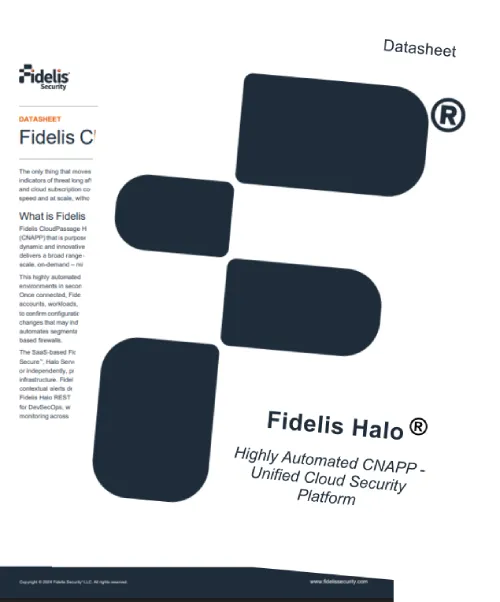
Fidelis Halo® provides comprehensive cloud security across infrastructure and workloads, enabling detect cloud misconfigurations and fix cloud misconfigurations at enterprise scale.
Measuring CNAPP Success in Cloud Security Posture Management
Organizations implementing CNAPP report significant improvements in misconfiguration detection and remediation speed through continuous CSPM.
Key metrics include reduced configuration drift, faster MTTR, cleaner IAM permissions, and improved audit readiness across multi-cloud environments.
CNAPP platforms like Fidelis Halo® transform detecting misconfigurations in multi-cloud environments from reactive firefighting to proactive prevention. Comprehensive cloud security posture management prevents cloud security incidents and data breaches before exploitation.
References:
The post How Do CNAPP Platforms Help Prevent Misconfigurations Across Multi-Cloud Environments? appeared first on Fidelis Security.
No Responses