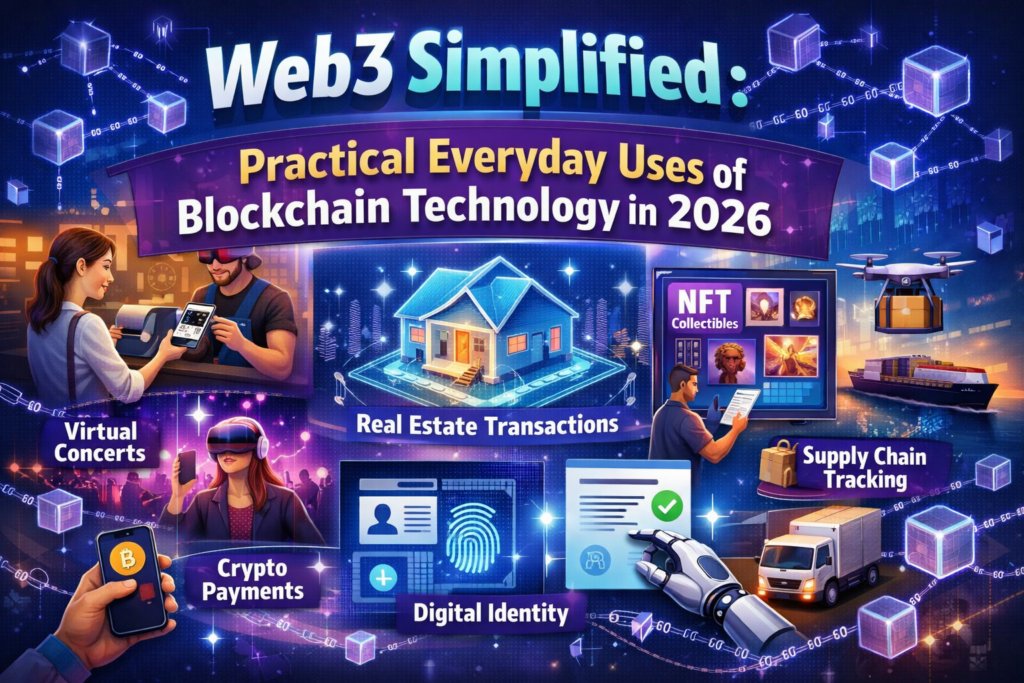
Practical everyday uses of blockchain technology are no longer a futuristic dream; they are actively reshaping how we interact with the digital world today. For a long time, the conversation around blockchain was stuck in a loop of financial speculation. But as the technology matures, we are discovering that the most profound changes are the ones that affect our daily routines.
Today, Web3 is the silent engine powering your morning coffee purchase, securing your medical records, and ensuring that the “organic” label on your grocery store apples actually means something. It’s about moving away from an internet owned by a few giant companies and toward an internet where you—the user—actually own your slice of the digital pie. In this deep dive, we’re exploring how this technology has become a grounded reality through various practical everyday uses of blockchain.
What Exactly is Web3? (The No-Nonsense Guide)
Before we get into the “where,” we need to understand the “what.” Web3 is essentially the third generation of the internet. If Web1 was “read-only” (static pages) and Web2 was “read-write” (social media), Web3 is “read-write-own.”
How It Works (The “Plain English” Version)
Imagine a giant, digital notebook that everyone can see but nobody can erase. Every time something happens—a payment or a data update—it gets written in this notebook. Because thousands of computers around the world hold a copy, you can’t “hack” it or change the past. This creates trust without a middleman. This mechanism is what allows for the many practical everyday uses of blockchain we see in 2026.
To see this in action, you can explore Etherscan, which acts like a search engine for one of the world’s largest blockchains, showing how transparency works in real-time.
1. Finance: Your Wallet, But Smarter
The world of money is usually the first place people see practical everyday uses of blockchain. But we aren’t just talking about trading; we’re talking about Decentralized Finance (DeFi), which is essentially a 24/7 bank that lives on the internet.
Instant Cross-Border Payments
Remember the last time you tried to send money abroad? You likely dealt with high fees and a 3-day waiting period. In a Web3 world, using Stablecoins—digital assets pegged to the dollar—you can send funds to someone across the globe in seconds. This is one of the most immediate practical everyday uses of blockchain for travelers and remote workers.
Programmable Money (Smart Contracts)
Smart contracts are bits of code that automatically execute an action when certain conditions are met.
Rental Agreements: Imagine a security deposit held in a “smart vault.” The code says: “If the digital key is returned, release the money to the tenant immediately.”
Freelance Escrow: The moment a file is uploaded to the blockchain, the payment is released from the client’s pre-funded account.
Micro-investing through Tokenization
Historically, investing in real estate was for the wealthy. Now, practical everyday uses of blockchain allow for “fractional ownership.” Platforms like Lofty allow you to buy a $50 “token” representing a piece of a rental property, earning you monthly rent directly to your wallet.
2. Healthcare: Your Data, Your Control
Healthcare is an industry notorious for being stuck in the past. We still use fragmented records that don’t talk to each other. One of the life-saving practical everyday uses of blockchain is the creation of a unified, patient-centric health record.
Unified Medical Records: With Web3, you own your health data. When you visit a new specialist, you grant them temporary “key access” to your encrypted records. Once the appointment is over, you revoke that access.
Drug Traceability: Pharmaceutical companies are now using blockchain to track every single bottle of medicine. By scanning a QR code, you can verify the journey of your prescription through systems like IBM Blockchain Transparent Supply.
3. Shopping and Supply Chains: The End of “Fake”
Trust is the new currency. Whether you’re buying a luxury handbag or a carton of milk, practical everyday uses of blockchain provide a “digital passport” for products.
Verified Authenticity: Brands like Louis Vuitton use blockchain to issue digital certificates of ownership. If you’re buying a second-hand bag, you can instantly verify it’s real via a ledger like Arianee.
Ethical Sourcing: As consumers, we care more than ever about where our products come from. You can scan a bag of coffee and see exactly which farm grew the beans and what price the farmer was paid. This level of transparency is among the most impactful practical everyday uses of blockchain.
4. Digital Identity: Goodbye, 500 Different Passwords
We are all suffering from “password fatigue.” Self-Sovereign Identity (SSI) is perhaps the most useful of all practical everyday uses of blockchain. Instead of “Logging in with Facebook,” you use a Web3 Wallet like MetaMask.
Your wallet proves who you are without revealing your personal details.
You can prove you are over 21 without sharing your exact birth date.
You own your identity, meaning a social media platform can’t “delete” your digital existence.
5. Content Creation: Giving Power Back to Artists
In the Web2 world, platforms take a massive cut of an artist’s earnings. Practical everyday uses of blockchain allow for a direct relationship between the creator and the fan.
Music: Musicians can release tracks where fans actually own a percentage of the royalties.
Social Media: Imagine owning your content. If you decide to leave a platform, you take your followers and posts with you. This shift is a core part of the practical everyday uses of blockchain for the creator economy.
The Benefits: Why Does This Matter?
Why is the world shifting toward these practical everyday uses of blockchain?
Security: There is no central server for a hacker to target.
Transparency: You don’t have to “take someone’s word for it.” You can see the proof on the ledger.
Efficiency: By removing the middleman, things happen faster and cheaper.
Ownership: For the first time, you can actually own a digital item just like you own a physical car.
The Challenges: Why Isn’t It Everywhere Yet?
While the practical everyday uses of blockchain are growing, we aren’t quite at the “Mass Adoption” stage. There are still hurdles:
The Learning Curve: Phrases like “Seed Phrases” are still too complicated for many.
Regulation: Governments are still trying to figure out how to regulate this space.
Scalability: Handling billions of transactions at once requires constant technical upgrades.
Future Trends: The “Invisible” Blockchain
The most exciting thing about the future of this technology is that it will eventually become invisible. You won’t say, “I’m using a blockchain-based identity system.” You’ll just say, “I’m logging in.”
We are moving toward a world of DAOs (Decentralized Autonomous Organizations). Imagine a ride-sharing app owned and run by the drivers themselves through a blockchain voting system. You can see how these communities are already making decisions on platforms like Snapshot. The more we see these practical everyday uses of blockchain, the more the technology blends into the background.
Conclusion: Embracing the Decentralized Future
The practical everyday uses of blockchain have moved out of the developer labs and into our pockets. This isn’t just a “tech thing” anymore; it’s a “people thing.” It’s about getting our privacy back and making our digital lives more secure.
Whether you’re a creator looking for fair pay or a shopper looking for authenticity, the blockchain revolution is here to stay. The next time you hear the word blockchain, don’t think of a complex algorithm—think of the practical everyday uses of blockchain that are finally giving you the keys to your own digital kingdom.
Onward and upward to a more decentralized world!
No Responses