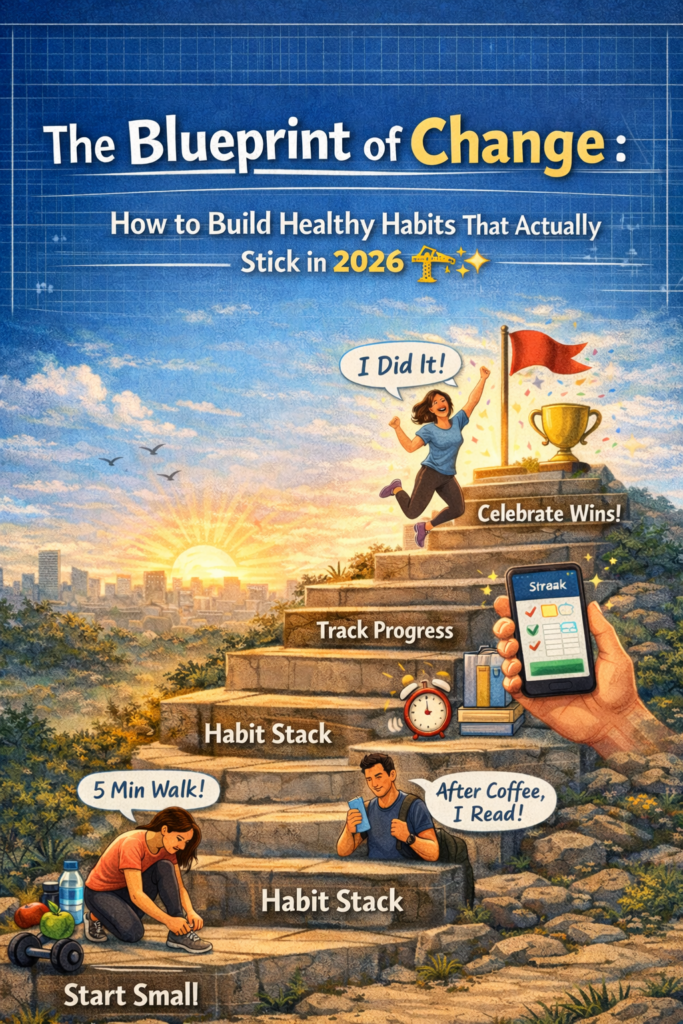
We’ve all been there. It’s January 1st (or a random Monday morning), and you are fired up. You’re going to hit the gym every day, drink two liters of water, meditate for twenty minutes, and swear off sugar forever. But by Thursday? The gym bag is gathering dust, and the siren song of a glazed donut is winning the battle.
Why is it so hard to make the good stuff stick?
In 2026, we’ve moved past the old myth that it takes exactly “21 days” to form a habit. Modern behavioral science tells a much more interesting story. Building healthy habits isn’t about having superhuman willpower; it’s about understanding the “wiring” of your brain and designing an environment that makes success inevitable. Whether you want to boost your physical fitness, improve your mental clarity, or finally master a consistent sleep schedule, the secret lies in the system, not the struggle.
Let’s break down the science-backed blueprint for building lasting change.
What is a Habit and How Does the “Habit Loop” Work?
A habit is essentially a mental shortcut. Your brain is a massive energy-hog, so it’s constantly looking for ways to automate repetitive tasks to save “battery life.” This automation happens through a three-part neurological pattern known as the Habit Loop:
The Cue (The Trigger): This is the “start button” for your brain. It could be a time of day, a specific location, or an emotional state (like feeling stressed).
The Routine (The Action): This is the behavior itself—like grabbing a snack or going for a run.
The Reward (The Finish Line): This is the “prize” that tells your brain, “Hey, that felt good! Let’s do it again next time.”
In 2026, we also recognize the Investment phase—the long-term data tracking via wearables that reinforces our identity as someone who prioritizes health. When these three (or four) elements lock together, the behavior moves from the conscious “thinking” part of your brain to the basal ganglia, where it becomes automatic.
5 Proven Tips to Build Healthy Habits Today
1. Start with “Mini Habits” (The 2-Minute Rule)
The biggest mistake people make is starting too big. If you want to start a flossing habit, don’t try to floss your whole mouth on day one. Floss one tooth.
How it works: Make the habit so small that it’s impossible to say no. Want to read more? Read one page. Want to exercise? Put on your running shoes and walk to the end of the driveway.
Why it works: It bypasses the brain’s “resistance” reflex. Once you start, you’ll often find the momentum carries you further, but the goal is only the first two minutes.
2. Master the Art of “Habit Stacking”
You don’t need to find extra time in your day; you just need to anchor new habits to existing ones. This is a powerful technique popularized by experts like James Clear and BJ Fogg.
The Formula: “After I [Current Habit], I will [New Habit].”
Example: “After I pour my morning coffee (current habit), I will take my vitamins (new habit).”
Example: “After I close my laptop for the day, I will do 5 minutes of stretching.”
3. Design Your Environment for Success
Willpower is a finite resource that runs out by 5:00 PM. Instead of fighting your environment, optimize it.
Make the Good Easy: If you want to eat more fruit, put a bowl of apples in the center of the table, not tucked away in the fridge drawer.
Make the Bad Hard: If you scroll too much on your phone at night, leave the charger in another room. Add “friction” to the habits you want to break.
4. Use “Immediate Rewards” to Hack Your Brain
The problem with healthy habits like exercise or eating salad is that the reward (weight loss or health) is delayed. Meanwhile, the reward for eating pizza is instant.
The Strategy: Attach an immediate, “guilt-free” reward to your healthy habit. Listen to your favorite podcast only while you are at the gym. Or, use a Habit Tracking App that gives you digital “experience points” for every task completed.
The Goal: Make the healthy choice feel good in the moment.
5. Prioritize “Mental Repetition” over Perfection
Research in 2026 shows that missing one day doesn’t ruin your progress, but missing two days is the start of a new habit.
The Mindset: Use the “Never Miss Twice” rule. If life gets messy and you miss a workout, don’t beat yourself up. Just make sure the next session is non-negotiable.
Pro Tip: Visualize yourself performing the habit when you aren’t doing it. Studies suggest that mental rehearsal strengthens the neural pathways almost as much as physical practice.
The Massive Benefits of Habit Formation
Why put in the effort? Because healthy habits are the “compound interest” of self-improvement:
Reduced Decision Fatigue: When your morning routine is automatic, you save your brainpower for the big, creative decisions that actually matter.
Physical Longevity: Small, consistent actions (like daily walks and 8 hours of sleep) do more for your lifespan than any “detox” or “biohack” ever could.
Boosted Confidence: Every time you keep a small promise to yourself, you build “self-trust.” You begin to see yourself as the type of person who can change.
Emotional Stability: Habits like journaling or a Digital Detox create a “mental buffer,” helping you stay calm even when the world gets chaotic.
The Challenges: Why We Fall Off the Wagon
Let’s keep it real—it’s not always sunshine and rainbows. You will face hurdles:
The “Valley of Disappointment”: This is the period where you’re putting in the work, but you don’t see results yet. The Fix: Focus on the “system,” not the goal. Celebrate the fact that you showed up, regardless of the scale.
Social Pressure: Friends might mock your new “early to bed” routine. The Fix: Share your “Why” with them. True friends will support your growth.
Stress and Fatigue: When we’re tired, we revert to our “default” settings (usually old, bad habits). The Fix: Have a “Plan B” for bad days. If you’re too tired for a 30-minute workout, do a 1-minute plank. Just keep the streak alive.
Future Trends: AI and the “Neurowellness” Revolution
As we move through 2026, tech is becoming our secret weapon in habit formation:
AI Habit Coaches: Imagine an AI that doesn’t just remind you to drink water but analyzes your sweat via your smartwatch and tells you exactly how many electrolytes you need.
Predictive Analytics: Wearables will soon predict when you are about to “slip up” based on your heart rate and sleep data, sending you a motivational nudge before you even feel the craving.
Micro-Dosing Wellness: The trend is shifting away from “1-hour blocks” of health and toward “micro-actions”—30-second breathing breaks or 2-minute “movement snacks” integrated into your digital workflow.
Conclusion: Your Future is Built One Minute at a Time
Building healthy habits isn’t a destination; it’s a practice. It’s about the quiet satisfaction of knowing you are taking care of the only body and mind you’ll ever have. You don’t need to be perfect; you just need to be consistent.
In 2026, the most successful people aren’t the ones with the most willpower—they are the ones with the best systems. So, pick one tiny habit, anchor it to something you already do, and start today. Your future self will thank you for the small step you took this afternoon.
No Responses