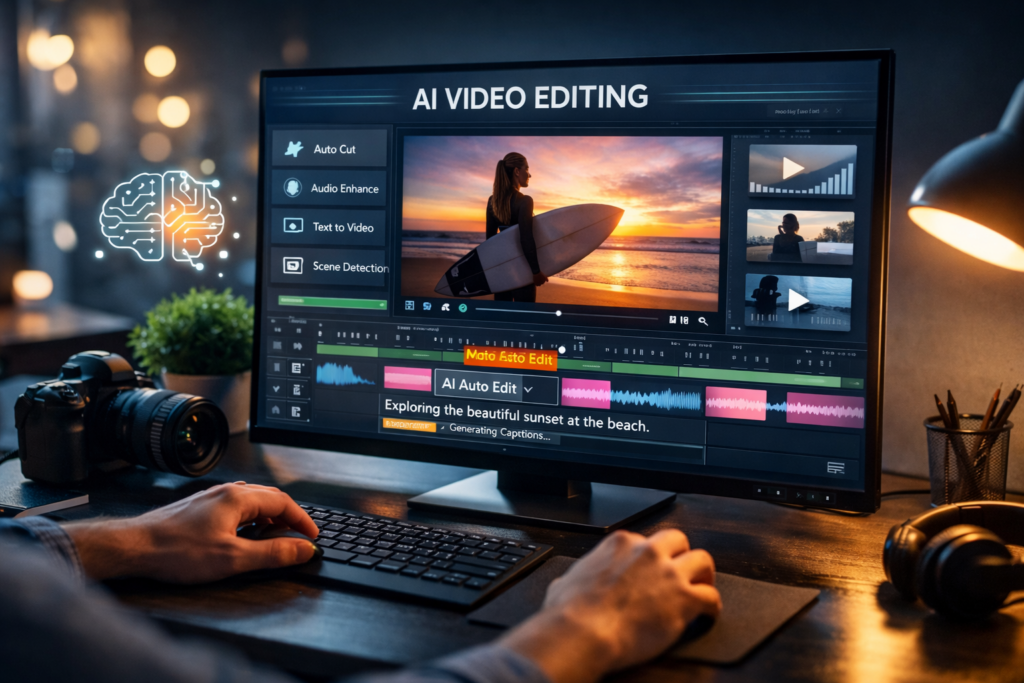
The world of video is exploding. From TikToks to YouTube epics, professional presentations to personal vlogs, video content dominates our screens and our attention. But let’s be honest, creating compelling videos can be a time-consuming, complex beast. Hours spent sifting through footage, painstakingly cutting clips, finessing transitions, and agonizing over audio – it’s enough to make even the most dedicated creator throw in the towel.
But what if there was a way to reclaim those hours? What if you could harness the power of artificial intelligence to automate the tedious tasks, unleash your creativity, and produce stunning videos faster and more efficiently than ever before?
Enter AI video editing tools. These revolutionary platforms are changing the game, empowering everyone from seasoned professionals to absolute beginners to create captivating video content with unprecedented ease. In this comprehensive guide, we’re diving deep into the world of AI video editing, exploring how it works, its incredible benefits, the challenges it faces, future trends, and most importantly, highlighting the absolute best AI video editing tools available right now. Get ready to transform your video creation process forever!
What Exactly is AI Video Editing?
At its core, AI video editing leverages artificial intelligence and machine learning algorithms to automate and enhance various aspects of the video production workflow. Think of it as having a highly intelligent assistant who can understand your footage, anticipate your needs, and perform complex editing tasks with incredible speed and accuracy.
Instead of manually performing every single cut, trim, and effect, AI tools can analyze your video and audio data to identify key moments, detect objects and faces, transcribe speech, apply intelligent color corrections, stabilize shaky footage, and even generate entire video sequences based on your input. It’s a fundamental shift from traditional, labor-intensive editing to a more intuitive, AI-driven creative process.
How Does AI Video Editing Work Its Magic?
The magic behind AI video editing lies in sophisticated algorithms trained on vast datasets of video and audio. Here’s a simplified breakdown of some common ways these tools operate:
Machine Learning (ML): ML models learn from patterns in existing videos. For instance, a model can be trained to recognize common editing styles, optimal transition points, or even emotional cues in music. This allows the AI to suggest or automatically apply edits that align with professional standards.
Computer Vision: This branch of AI enables machines to “see” and interpret visual information. In video editing, computer vision can detect objects (e.g., cars, people, animals), identify faces, track motion, and understand scene changes. This is crucial for tasks like automatic subject tracking, object removal, or scene segmentation.
Natural Language Processing (NLP): NLP allows AI to understand, interpret, and generate human language. For video editing, NLP is vital for automatic transcription of dialogue, sentiment analysis (understanding the mood of spoken words), and even generating video content from text prompts. Imagine typing “create a montage of happy moments from my vacation” and the AI understanding and executing that request!
Generative AI: This cutting-edge AI can create new content, not just analyze existing data. In video editing, generative AI can produce synthetic media, generate unique background music, or even create entirely new video clips or animations based on specific parameters.
These technologies combine to create powerful tools that can analyze, understand, and manipulate video content in ways that were once thought impossible or incredibly time-consuming.
The Game-Changing Benefits of Embracing AI Video Editing
The advantages of integrating AI into your video editing workflow are numerous and impactful, making it a must-consider for anyone serious about video creation.
Massive Time Savings: This is perhaps the most significant benefit. AI automates repetitive and time-consuming tasks like cutting out silences, stabilizing footage, transcribing interviews, and even generating initial rough cuts. What once took hours can now be done in minutes, freeing up valuable time for more creative endeavors.
Increased Efficiency & Productivity: With AI handling the grunt work, you can produce more videos in less time. This is invaluable for content creators, marketers, and businesses that need to maintain a consistent output of high-quality video.
Enhanced Creativity & Focus: By offloading the mundane, AI allows you to concentrate on the creative aspects of storytelling, pacing, and visual style. You can experiment more, try new ideas, and focus on refining your message without getting bogged down in technicalities.
Professional Results, Easier: AI tools can apply professional-grade color grading, audio enhancements, and intelligent cuts that might otherwise require advanced skills or expensive software. This democratizes high-quality video production, making it accessible to a broader audience.
Cost-Effectiveness: While some AI tools have subscription fees, they can significantly reduce the need for specialized editors or extensive training. For small businesses or individual creators, this translates into considerable cost savings.
Accessibility for Beginners: Don’t know the first thing about video editing software? Many AI tools offer intuitive interfaces and automated features that make it incredibly easy for novices to create impressive videos without a steep learning curve.
Personalization and Customization at Scale: AI can help tailor video content to specific audiences by analyzing engagement data and suggesting optimal edits or variations. This is particularly powerful for marketing and advertising.
Navigating the Challenges of AI Video Editing
While the future of AI video editing is bright, it’s not without its hurdles. Understanding these challenges helps set realistic expectations and informs the direction of future development.
The “Black Box” Problem: Sometimes, AI outputs can feel a bit like magic, making it hard to understand why the AI made a particular editing choice. This can be frustrating for editors who want precise control over every detail.
Lack of Nuance and Artistic Vision: While AI can mimic styles, it currently lacks the intuitive artistic sensibility of a human editor. It can’t truly understand the subtle emotional impact of a particular shot or the perfect comedic timing for a cut. Human oversight is still crucial for creative direction.
Dependency on Data Quality: The effectiveness of AI models heavily relies on the quality and diversity of the data they are trained on. Biased or limited datasets can lead to biased or suboptimal editing suggestions.
Learning Curve for Advanced Features: While basic AI features are user-friendly, mastering the more advanced AI capabilities and integrating them seamlessly into a professional workflow can still require some learning.
Ethical Considerations and Deepfakes: As AI becomes more sophisticated, the ability to generate realistic but fabricated video content (deepfakes) raises serious ethical concerns about misinformation and authenticity. Responsible development and usage are paramount.
Computational Demands: Processing and rendering AI-generated video can be computationally intensive, requiring powerful hardware or cloud-based solutions, which might be a barrier for some users.
Future Trends: Where is AI Video Editing Headed?
The pace of innovation in AI is staggering, and video editing is at the forefront of this revolution. Here’s a glimpse into the exciting future trends we can anticipate:
Hyper-Personalized Video Generation: Imagine AI creating unique video ads or content tailored to each individual viewer’s preferences, viewing history, and even mood.
Voice and Text-to-Video Creation: Simply describe the video you want, or provide a script, and AI will generate it, selecting appropriate stock footage, creating animations, and even generating voiceovers.
Real-time AI Editing: AI tools will offer instant, real-time suggestions and edits as you shoot or import footage, making the editing process almost instantaneous.
Advanced Emotional Intelligence: AI will become better at understanding the emotional tone of content and viewers, allowing for more nuanced and impactful editing decisions that resonate deeply.
Seamless Integration with AR/VR: AI will play a crucial role in creating immersive and interactive video experiences for augmented and virtual reality platforms, making content creation for these mediums more accessible.
Ethical AI and Content Verification: Alongside advancements in generative AI, there will be increased focus on AI tools for detecting deepfakes and verifying the authenticity of video content, ensuring responsible use.
The Best AI Video Editing Tools You Need to Try Right Now
The market for AI video editing tools is booming, with new and innovative solutions emerging constantly. Here are some of the top contenders that are making waves and empowering creators worldwide:
1. Descript
Descript is a groundbreaking tool that redefines how we think about video editing. It focuses on a “text-based” approach, making video editing as intuitive as editing a document.
How it Works: Descript automatically transcribes your video and audio, allowing you to edit the video by simply editing the text transcript. Delete a word or sentence in the transcript, and the corresponding audio/video is cut. Drag and drop text, and the corresponding video moves.
Key Features: Automatic transcription, “Filler Word Removal” (uhm, ahh, you know), “Overdub” (AI voice cloning to correct mistakes or add new words), multi-track editing, screen recording, and podcasting tools.
Why it’s Great: Revolutionizes workflow for spoken-word content like podcasts, interviews, and tutorials. It makes precise cutting incredibly fast and efficient. The Overdub feature is truly futuristic and a massive time-saver for minor errors.
Best For: Podcasters, YouTubers, educators, content creators who primarily work with spoken dialogue, and anyone looking to streamline their audio and video editing based on transcripts.
2. RunwayML
RunwayML is a powerhouse of generative AI for creative professionals, offering a suite of tools that push the boundaries of what’s possible in video.
How it Works: RunwayML provides a comprehensive platform with various AI magic tools. From text-to-video generation (Gen-1 and Gen-2) to object removal, inpainting, motion tracking, and even generating entirely new video styles, it leverages advanced generative AI models.
Key Features: Text-to-Video (generating video from text prompts), Image-to-Video (animating static images), Object Removal, Inpainting, Background Removal, Motion Tracking, Frame Interpolation, and AI-powered visual effects.
Why it’s Great: It’s at the forefront of generative AI for video, offering unparalleled creative freedom to produce unique visual content or dramatically alter existing footage. Its tools are incredibly powerful for artists and filmmakers exploring new forms of visual storytelling.
Best For: Filmmakers, visual artists, motion designers, experimental content creators, and anyone interested in cutting-edge generative AI for video production.
3. Pictory
Pictory is designed to make video creation from text a breeze, ideal for transforming long-form content into engaging video snippets.
How it Works: You feed Pictory a script, article, or blog post, and its AI automatically analyzes the text, selects relevant stock video clips and images, adds music, and generates a cohesive video. It can also create short highlight reels from longer videos.
Key Features: Article to Video, Script to Video, Edit Video Using Text (similar to Descript in some ways), Video Highlights, automatic captions, and branding customization.
Why it’s Great: Incredibly fast for repurposing existing content into video format. It’s a fantastic solution for content marketers, bloggers, and businesses that need to quickly produce social media videos or short explainers without extensive video editing skills.
Best For: Content marketers, bloggers, small businesses, educators, and anyone who needs to quickly convert written content into engaging videos for social media or presentations.
4. Adobe Premiere Pro (with AI Features)
While not exclusively an AI tool, Adobe Premiere Pro, the industry-standard video editor, has integrated powerful AI features that enhance its capabilities.
How it Works: Adobe Sensei, Adobe’s AI engine, powers various intelligent features within Premiere Pro. This includes “Content-Aware Fill” for removing unwanted objects, “Auto Reframe” for adapting videos to different aspect ratios, “Speech to Text” for automatic transcription, and “Remix” for intelligently re-timing music to fit your video duration.
Key Features: Content-Aware Fill, Auto Reframe, Speech to Text, Remix (audio editing), enhanced color matching, and intelligent audio cleanup tools.
Why it’s Great: It combines the robust, professional editing environment of Premiere Pro with the efficiency of AI. For existing Premiere Pro users, these AI enhancements provide significant workflow improvements without switching platforms.
Best For: Professional video editors, filmmakers, broadcasters, and anyone already deeply entrenched in the Adobe ecosystem who wants to leverage AI within their established workflow.
5. CapCut
CapCut has exploded in popularity, especially among mobile creators, thanks to its user-friendly interface and powerful AI-driven features.
How it Works: CapCut offers a range of AI tools for both mobile and desktop. Its AI can automatically generate captions, remove backgrounds with green screen effects, apply trending effects, stabilize footage, and even generate creative templates for quick video creation.
Key Features: Auto Captions, Background Remover, Body Effects, AI Stylize, Text-to-Speech, intelligent tracking, and a vast library of templates, effects, and sounds.
Why it’s Great: It’s incredibly accessible, intuitive, and packed with features for creating viral-ready content, especially for platforms like TikTok and Instagram Reels. Its AI features make complex edits surprisingly easy.
Best For: Social media content creators, influencers, short-form video producers, and anyone looking for a powerful yet easy-to-use video editor with strong AI capabilities, particularly on mobile devices.
6. Veed.io
Veed.io is an online video editing platform designed for simplicity and speed, making video creation accessible to everyone.
How it Works: Veed.io leverages AI for tasks like automatic transcription, translation, background noise removal, and creating clean cuts. It’s an browser-based editor that prioritizes ease of use and quick turnarounds.
Key Features: Auto-subtitles, background noise removal, video translation, intelligent cropping, brand kit features, screen recording, and a vast stock media library.
Why it’s Great: Extremely user-friendly, cloud-based, and perfect for quick edits, adding subtitles, or cleaning up audio without needing powerful software or extensive editing knowledge.
Best For: Marketers, social media managers, educators, small businesses, and anyone who needs a straightforward online tool for quickly creating and editing videos with AI assistance.
7. HeyGen
HeyGen takes AI video creation to another level by focusing on generating professional-quality AI avatars and voiceovers.
How it Works: You select an AI avatar (or create your own), provide a script, and HeyGen’s AI generates a video of the avatar speaking your text with natural lip-syncing and expressions. You can customize voices, backgrounds, and even gestures.
Key Features: AI avatar generation, text-to-speech with various voices and languages, custom avatar creation, background customization, and template library.
Why it’s Great: Perfect for creating engaging explainer videos, corporate training, marketing content, or personalized messages without needing a human presenter, studio, or camera equipment.
Best For: Businesses, marketers, educators, and anyone needing to produce professional-looking explainer videos or presentations quickly and efficiently using AI avatars.
The Future is Now: Embrace AI in Your Video Workflow
The landscape of video creation is undergoing a radical transformation, and AI is at the helm. These innovative tools are no longer just futuristic concepts; they are here, they are powerful, and they are changing how we create, edit, and consume video content.
Whether you’re a seasoned professional looking to optimize your workflow, a budding content creator seeking an edge, or a business aiming to scale your video marketing efforts, there’s an AI video editing tool perfectly suited for your needs. The benefits – from unparalleled time savings and increased efficiency to democratized access to professional-grade results – are simply too significant to ignore.
While challenges remain, particularly in the realm of nuanced artistic control and ethical considerations, the rapid advancements in AI promise an even more exciting future. By integrating these intelligent tools into your video workflow today, you’re not just staying current; you’re future-proofing your content creation strategy and unlocking a new era of creative possibilities. Dive in, experiment, and prepare to revolutionize your video editing journey!
No Responses