Key Takeaways
Automated endpoint security cuts out the delays that kill manual approaches. Machine learning, behavioral analysis, and real-time threat intelligence work together to catch threats at speeds humans simply can’t reach. If you’re still doing this manually, you’re already behind.
Good endpoint protection doesn’t just spot misconfigurations. It needs to fix them automatically and stop active threats in real time. Behavioral analysis beats signature detection against sophisticated attacks. That’s not opinion, it’s proven.
Your endpoint solution has to integrate with your existing security stack (SIEM, SOAR, identity tools). Without that integration, you’re creating blind spots. Attackers know how to exploit those gaps.
Thousands of alerts hit analysts every day. Manual investigation means critical threats get buried in noise. Automation isn’t extra anymore. It’s how you survive against modern attacks.
Security teams are fighting a losing battle against threat velocity. Attackers keep refining their approach—developing techniques that sidestep signature-based antivirus and leave organizations exposed to breaches. Meanwhile, analysts drown in alerts, spending hours on manual triage while threats spread unchecked across networks.
This isn’t sustainable. Machine learning, behavioral analysis, and real-time threat intelligence have emerged as the answer, automating what humans simply can’t do at scale.
Consider what Verizon found when examining 22,000+ security incidents this year (12,195 confirmed breaches): vulnerability exploitation now represents 20% of initial access vectors. Ransomware presence jumped 37%. The gap between reactive and proactive security has never been clearer automation isn’t optional anymore[1].
Why Traditional Antivirus Protection Falls Short
Traditional antivirus software operates on signature-based detection, matching file signatures against known malware databases. This approach fails against modern threats for three critical reasons. Understanding these limitations explains why organizations are rapidly adopting automated solutions.
Zero Day Attacks Exploit Signature Gaps
Zero-day attacks exploit vulnerabilities before vendors can create signatures. Attackers get days or weeks of undetected access. According to the Verizon 2025 DBIR, organizations fully remediated only 54% of perimeter-device vulnerabilities. Almost half remained unresolved. This persistent exposure creates windows that threat actors actively exploit.
Traditional defenses require knowing what to look for before they can protect against threats. But modern attacks move too quickly. This reactive approach can’t remain effective against sophisticated threats anymore.
Advanced Persistent Threats Evade Detection
Advanced persistent threats use techniques specifically designed to evade signature detection. According to IBM’s X-Force 2025 Threat Intelligence Index, which analyzes global cybersecurity threats, identity-based attacks represented 30% of total intrusions for the second consecutive year as adversaries adopted stealthier methods using valid accounts[2].
Fileless malware, polymorphic code, and living-off-the-land attacks leave no signatures to detect. These techniques require behavioral analysis rather than static pattern matching. Signature-based systems cannot identify what they haven’t encountered before.
Manual Investigation Cannot Scale
Analysts wade through thousands of alerts every single day. Most turn out to be nothing. Critical threats? They’re the ones getting lost in all that noise. By the time teams spot a sophisticated attack (and eventually they do), it’s too late. Sensitive data’s already compromised, and attackers have burrowed in with persistence mechanisms. Even SOCs with solid headcount can’t handle the sheer volume.
Here’s what happens with manual processes: every step creates a delay. Triage? Delay. Investigation? Delay. Making the call on what to do? Another delay. Attackers aren’t waiting around during all this. They’re moving laterally, stealing credentials, grabbing whatever data they can access. Organizations simply can’t match attack speed and scale without automation. The numbers don’t lie.
Core Components of Automated Endpoint Security
Modern automated endpoint security relies on three fundamental components working in concert to detect and neutralize threats. Each component addresses specific security challenges while reinforcing the others to create comprehensive protection.
1. Behavioral Analysis and Machine Learning
Automated solutions monitor how applications and processes behave rather than relying solely on signatures. Machine learning algorithms establish baselines for normal activity, tracking process execution patterns, network connections, file modifications, and registry changes.
MITRE’s research on endpoint telemetry demonstrated that adversaries exhibit consistent behavioral patterns while interacting with systems, even as specific malware variants change. This consistency enables advanced threat detection focused on post-compromise adversary actions. The MITRE ATT&CK framework provides a knowledge base of adversary tactics and techniques that inform behavioral detection rules.
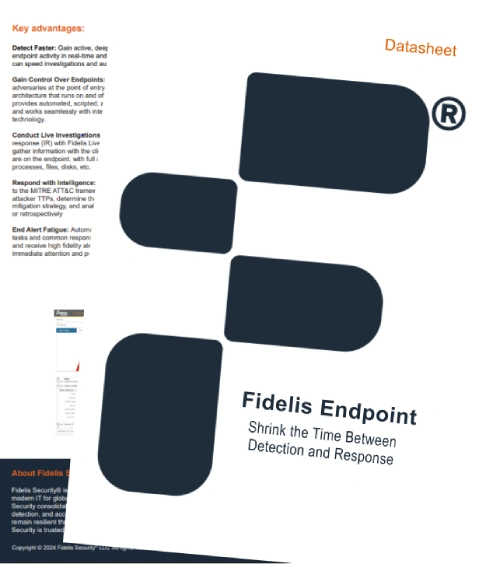
Fidelis Endpoint® captures metadata for every process and child process, including behaviors, registry changes, files created/modified/deleted, plus network activity. This comprehensive visibility enables real-time detection as each process is monitored. Detections trigger automated responses including process termination, isolation, or forensic analysis.
When suspicious behavior occurs, systems generate alerts or execute immediate responses. A spreadsheet application initiating network scans triggers an investigation. Unauthorized privilege escalation attempts result in process termination and isolation.
Machine learning continuously refines detection accuracy by analyzing outcomes. Systems adjust thresholds to reduce false positives while improving identification of genuine threats. This adaptive capability ensures detection quality improves over time without manual tuning.
2. Real-Time Threat Intelligence Integration
Effective threat detection requires current information about active attack campaigns. Advanced platforms integrate global threat intelligence feeds that provide indicators of compromise, attacker infrastructure details, and emerging exploit techniques. This integration happens automatically without requiring manual intervention.
When security researchers identify new attack vectors, solutions update detection rules within hours. Organizations gain protection against emerging threats as platforms access open feeds from third-party sources alongside internally developed intelligence. This multi-source approach ensures comprehensive coverage of the threat landscape.
The IBM X-Force 2025 Threat Intelligence Index revealed that phishing emerged as a shadow infection vector for identity attacks. Infostealers increased 84% in phishing emails as attackers focused on credential theft. Threat intelligence integration enables automated correlation of suspicious activity against these known malicious patterns.
Systems distinguish genuine threats from legitimate administrative tasks through this correlation. Analysts receive context-rich alerts rather than raw data requiring extensive investigation. This contextual intelligence transforms raw alerts into actionable insights.
Platforms map detections to the MITRE ATT&CK framework, helping teams understand attacker tactics, techniques, and procedures. This mapping determines optimal mitigation strategies. Teams gain visibility into not just what happened, but how it fits into broader attack patterns.
3. Automated Detection and Response
Speed determines breach impact in modern cyberattacks. EDR capabilities enable automated actions the moment threats are confirmed. Rapid response prevents attackers from achieving their objectives.
The Verizon 2025 DBIR noted that 54% of ransomware victims had prior credentials exposed in infostealer logs. Additionally, 40% contained corporate email addresses showing how rapidly attackers move from initial compromise to ransomware deployment. Automated systems address this speed through immediate response capabilities.
Fidelis Endpoint® provides over 100 response scripts covering investigative, forensic, and destructive use cases across Windows, Linux, and Mac systems. These capabilities execute predefined actions without waiting for analyst approval. Scripts collect data immediately following detection, capturing evidence within seconds before attackers remove traces.
Automated responses include multiple containment and remediation actions:
Isolate compromised systems from the network to prevent lateral movement while maintaining console access for investigation
Terminate malicious processes before they execute payloads
Quarantine suspicious files for forensic analysis
Block connections to command-and-control infrastructure
Revert unauthorized system changes automatically
These capabilities scale across multiple systems simultaneously. If attackers exploit the same vulnerability across fifty devices, automation ensures consistent remediation in minutes rather than days.
Automate detection and response with intelligent playbooks
Correlate threat intelligence across endpoints in real time
Simplify forensic investigations with one-click collection
Business Impact: How Automation Reduces Threats
Organizations implementing automated endpoint security experience measurable improvements across four critical areas. These benefits directly address the operational and financial challenges posed by modern cyber threats.
1. Faster Detection Closes Security Gaps
Attack dwell time—the period between initial compromise and detection—remains a critical metric affecting breach severity. Longer dwell times allow attackers to establish deeper footholds and cause more extensive damage. Automated solutions reduce detection windows through continuous monitoring and real-time analysis.
Behavioral analysis identifies subtle indicators that manual reviews overlook. Attackers establishing persistence through scheduled tasks trigger immediate alerts. Creating unauthorized accounts or exfiltrating small data volumes also generates automated detection.
Teams discover breaches in early stages rather than after extensive damage occurs. This dramatically reduces the window of opportunity for sophisticated threats. The combination of visibility and threat intelligence provides detection of even the most advanced attacks.
Systems monitor activity on and off the network, maintaining protection even when employees work remotely. Organizations supporting hybrid workforces approaching 2026 require this continuous coverage capability.
2. Reduced Response Time Limits Damage
Manual incident response follows predictable patterns: alert generation, triage, investigation, containment decision, and remediation execution. Each step introduces delays that attackers exploit. Every minute of delay allows threats to spread further across the network.
Automated systems collapse this timeline by executing predefined workflows without waiting for human approval. For common threats, automation handles the complete response cycle. Analysts only review complex incidents requiring judgment calls.
Forrester’s research on managed detection and response emphasized that integrating detection, response, and forensics into unified workflows reduces containment delays. Organizations implementing automation experience substantial operational savings. Automated response executes in seconds—isolating systems, terminating processes, and initiating forensic collection before threats spread.
3. Operational Efficiency at Scale
Organizations supporting hybrid workforces face maintaining consistent security posture across distributed environments. Employees work from homes, branch offices, and temporary locations using laptops, mobile devices, and cloud workloads. Managing security across this dispersed infrastructure strains traditional approaches.
Automated solutions provide comprehensive visibility across distributed infrastructure. Cloud-based management enables consistent policy enforcement regardless of location. Operations teams monitor entire attack surfaces from centralized platforms rather than managing segmented tools.
This efficiency translates to measurable cost savings. Organizations protect expanding infrastructure without proportionally increasing staff. Automated systems handle routine tasks while analysts tackle strategic initiatives like threat hunting and architecture improvements.
4. Enhanced Detection Accuracy
Alert fatigue represents a serious operational risk. Analysts reviewing thousands of notifications daily develop blind spots. Critical threats get missed among false positives and low-priority alerts.
Automation filters alerts using multiple data sources including threat intelligence. Systems correlate telemetry, network patterns, and intelligence to assess risk accurately. High-confidence threats receive immediate attention while low-risk events route to automated handling.
Machine learning improves accuracy by analyzing outcomes. When analysts mark alerts as false positives, systems adjust detection thresholds to reduce similar alerts. This feedback loop refines threat detection over time, reducing false positive rates while improving accuracy.
Implementation Considerations for Decision-Makers
Successful deployment of automated endpoint security requires careful evaluation of platform capabilities and organizational requirements. Decision-makers must balance technical features with operational realities to maximize security outcomes.
Evaluating Platform Capabilities
Not all solutions deliver equivalent automation capabilities. Organizations must evaluate platforms based on specific criteria that impact security effectiveness. Making informed technology decisions requires understanding these key differentiators.
Detection Coverage
Systems should monitor file activity, process execution, network connections, registry modifications, and memory operations. Comprehensive visibility prevents attackers from exploiting monitoring gaps. The NIST Cybersecurity Framework emphasizes detection capabilities as a core function, requiring organizations to implement continuous monitoring activities.
Retrospective analysis capabilities enable teams to investigate historical data for 30-, 60-, or 90-day windows. This temporal depth proves essential when investigating sophisticated attacks. Attackers often establish footholds weeks before detection occurs.
Response Flexibility
Platforms require automated capabilities that balance speed with control. Organizations need options ranging from passive alerting to aggressive auto-remediation depending on threat severity. The ability to customize scripts and create playbooks ensures workflows adapt to specific organizational needs.
Different threat scenarios demand different response approaches. Critical infrastructure may require human approval before isolation. Non-critical systems can leverage fully automated containment.
Integration Potential
Platforms should connect with existing infrastructure—SIEM systems, network security tools, identity management, and SOAR platforms. Integration enables correlation across security domains. REST APIs support custom integration requirements.
The NIST Cybersecurity Framework supports interoperability with frameworks like ISO 27001. This enables organizations to build unified security architectures. Seamless data sharing across tools eliminates operational silos.
Scalability
Solutions must handle current counts while supporting growth. Platforms managing hundreds to hundreds of thousands of devices require dynamic groups. These groups automatically update based on characteristics, enabling improved segmentation and easier policy management.
Balancing Automation with Oversight
Complete automation isn’t always appropriate. High-risk responses affecting production systems often warrant human approval before execution. Organizations should establish clear escalation policies defining when automated actions proceed immediately versus when teams review first.
The optimal approach uses automation for routine threats while reserving human expertise for complex investigations. Automated systems provide analysts with detailed forensic data—process trees, network connections, file modifications, and timeline reconstruction. This accelerates manual reviews when judgment calls become necessary.
Fidelis Endpoint® enables this balance through playbooks that join prebuilt rules and responses. These playbooks automatically trigger specific actions based on validated alerts. Customization accommodates unique organizational requirements without sacrificing response speed.
Alert subscriptions can be configured by severity for email, Microsoft Teams, and Slack. Teams receive high-fidelity alerts for issues demanding immediate attention. Automated workflows handle routine responses without generating alert fatigue.
Measuring Security Effectiveness
Automated solutions deliver measurable improvements across multiple metrics. Organizations should track these key performance indicators to validate automation ROI. Regular measurement identifies areas needing refinement.
Key Metrics to Monitor
Mean time to detect decreases as continuous monitoring replaces periodic scans. Mean time to respond drops when automated workflows eliminate manual steps. False positive rates decline as machine learning refines accuracy.
Team productivity improves as automation handles routine tasks. Overall security posture strengthens through consistent policy enforcement. These improvements translate directly to reduced organizational risk.
Vulnerability Management
Organizations should monitor software inventory and correlate against known vulnerabilities from MITRE CVE databases. This enables proactive remediation before attackers engage in exploit attempts. The IBM X-Force 2025 report noted that attackers exploited vulnerabilities in more than one-quarter of incidents across critical sectors.
Outdated systems and slow patching cycles proved to be enduring challenges. Automated vulnerability assessment addresses this gap. Systems continuously monitor for new CVEs affecting installed software.
Advanced Capabilities for Mature Operations
Organizations with mature security operations can leverage advanced capabilities that extend beyond basic threat detection and response. These capabilities enable proactive defense and comprehensive security coverage.
Threat Hunting and Forensic Investigation
Proactive threat hunting requires searching for indicators of compromise before attacks fully execute. Automated systems conduct persistent hunts across entire infrastructure. These platforms search for subtle anomalies suggesting attacker presence.
Advanced query builders with Boolean logic support experienced analysts in conducting sophisticated investigations. This capability extends beyond basic faceted search functionality. Teams can construct complex queries that identify unusual patterns across thousands of devices.
Solutions that collect first-time-seen executable files and scripts save clean copies for analysis. This proves critical when attacks delete or hide files to evade detection. Threat hunting and incident scoping benefit from having these preserved artifacts.
Memory analysis capabilities extend investigation depth. Analysts can identify threats that avoid disk residence altogether. Full memory capture and analysis provide definitive answers about how adversaries breached systems, their actions once inside, and whether they maintain persistent access.
Vulnerability Management and Security Hygiene
Effective protection extends beyond threat response to preventive measures. Solutions that create catalogs of all installed software perform daily vulnerability analysis. Organizations can correct issues before attackers engage in exploit attempts.
Correlation with MITRE CVE databases and Microsoft KB articles provides teams with immediate awareness. Teams know instantly when new vulnerabilities affect software installed across their environment. This agent-based approach provides more comprehensive analysis than external scans while consolidating security tools.
The Verizon 2025 DBIR found that edge device vulnerabilities grew nearly eight-fold year over year. This highlights the critical importance of continuous vulnerability assessment. Organizations cannot rely on periodic scanning to maintain security hygiene.
Integration with Broader Security Architecture
Automated solutions function most effectively when integrated with broader security tools. Correlation between activity and network security systems enables comprehensive threat detection. SIEM platforms and identity management complete the security picture across multiple domains.
Bi-directional integration allows external systems to trigger predefined response templates. Collected forensic data pushes back to centralized platforms. This seamless workflow eliminates “swivel chair” operations where analysts manually correlate data across disconnected tools.
The NIST Cybersecurity Framework’s Govern function emphasizes integrated decision-making connecting security with business objectives. Modern platforms support this integration through open APIs and standard protocols.
The Path Forward
Cybersecurity threats will continue evolving in sophistication and volume through 2026 and beyond. Attackers leverage automation to scale attacks across thousands of targets simultaneously. Organizations cannot combat automated attacks using manual defenses—the speed asymmetry creates unacceptable risk.
Automated endpoint security represents a strategic investment in organizational resilience. Automated systems detect emerging threats, respond to active attacks, and maintain security posture across hybrid environments. These capabilities reduce operational burden on teams while improving security outcomes.
The Verizon 2025 DBIR revealed that third-party involvement in breaches doubled to 30%, driven by vulnerability exploitation and business interruptions. Comprehensive visibility remains essential as attack surfaces expand. Platforms must address these expanding threat vectors.
The question facing security leaders isn’t whether automation belongs in strategy. It’s how quickly organizations can implement these capabilities. Delayed adoption extends exposure to sophisticated attacks that traditional antivirus cannot stop.
Organizations embracing automated solutions gain significant advantages defending against evolving threats while improving operational efficiency. Costs associated with breach response decrease substantially with proactive automated defenses.
Frequently Ask Questions
What should organizations look for in endpoint security solutions for hybrid workforces?
Solutions designed for hybrid workforces deliver consistent protection regardless of location. Prioritize platforms with these key capabilities:
Cloud-based management that enables centralized control across distributed devicesAutomated policy enforcement across all devices regardless of locationReal-time visibility into remote systems and off-network devicesThreat detection on devices outside corporate networksImmediate incident response capabilities for remote endpointsSingle-agent architecture that functions both on and off the networkLocal detection capabilities so threats are identified even without network connectivityData caching that stores detection information until devices reconnectComprehensive device management covering corporate-owned and BYOD devices
The Verizon 2025 DBIR found that 46% of compromised systems with corporate credentials were non-managed devices, highlighting BYOD risks and the importance of robust management across all devices accessing corporate resources.
How do endpoint security solutions compare to each other?
Platforms vary significantly in automation sophistication, detection accuracy, and deployment complexity. Organizations should evaluate solutions based on these key differentiators:
Core Detection Capabilities
Behavioral analysis depth and accuracyThreat intelligence integration qualityResponse automation granularity and flexibilityScalability across diverse device types
Threat Intelligence & Detection
Support for open threat intelligence standardsCustom internal indicator creationBehavioral rules beyond atomic indicatorsDetection of suspicious activity patterns
Forensic & Investigation Features
File collection capabilitiesFull memory dump supportComplete disk imagingHistorical analysis and retrospective search
Advanced Management Features
Query builders with Boolean logic for complex investigationsDynamic grouping for simplified policy management at scaleIntegration with SIEM, SOAR, and other security tools
Independent Validation
The MITRE ATT&CK evaluation framework provides independent assessment of detection capabilities, with recent evaluations showing significant variation in detection rates across vendors.
The post Automated Endpoint Security Solutions: How Do They Reduce Threats? appeared first on Fidelis Security.
No Responses