It is closing time at a busy laundry shop. The machines have stopped, but the owner is still matching receipts to bags, answering delivery messages and searching for a missing shirt. None of this work cleans another garment. Yet it takes time every day.
For independent laundry businesses, automation need not mean replacing staff or buying expensive machinery. The best starting point is often a better way to manage orders, track garments and communicate with customers. Here is how to identify the right investment and measure whether it pays off.
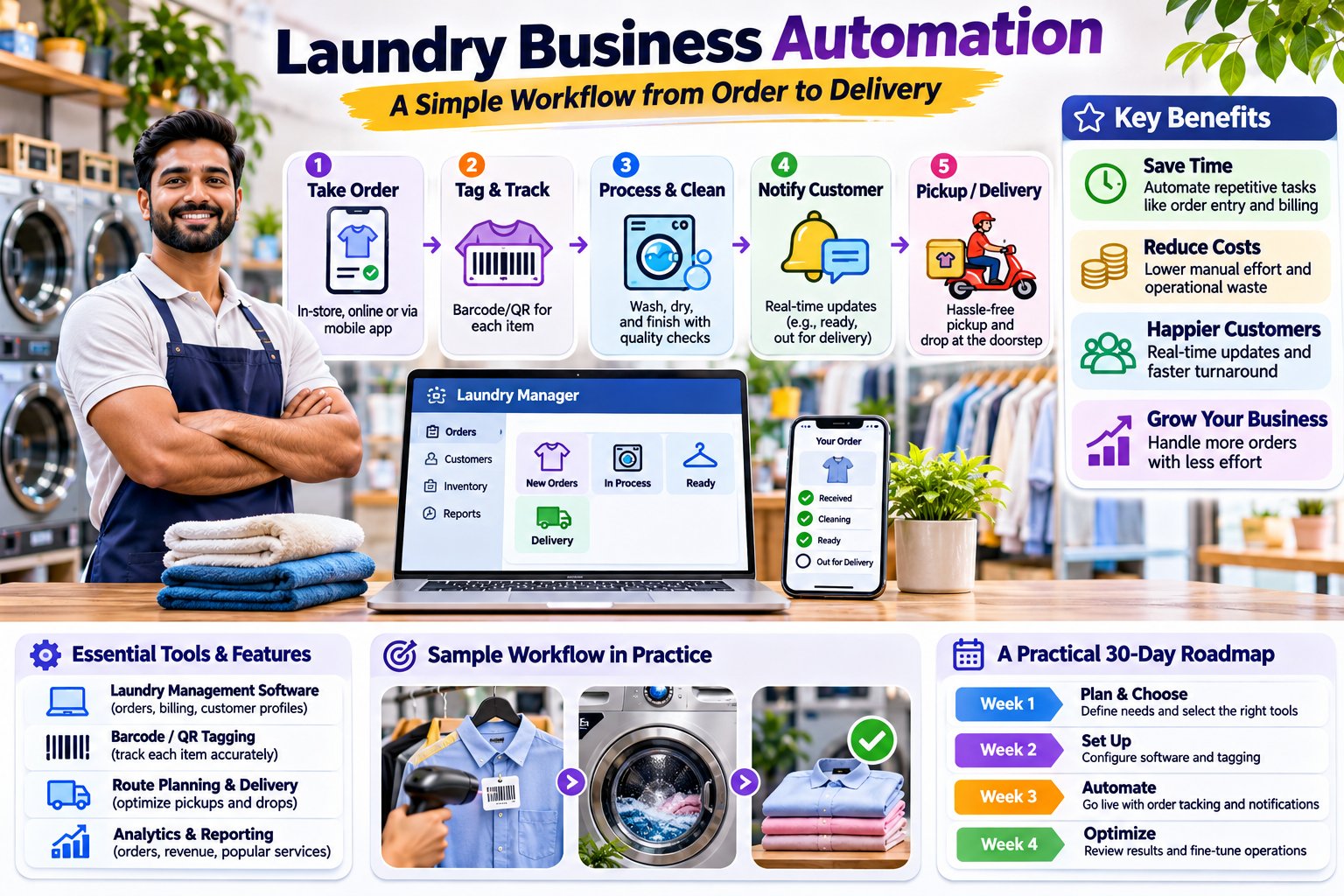
Illustrative workflow and potential benefits; results depend on implementation.
Start with the order journey
Follow one order from booking to collection. At intake, assign a unique order number, record garment condition and confirm the promised delivery date. A barcode links each bag or garment to that record. During washing and finishing, staff update the status at a few meaningful checkpoints rather than logging every movement. At dispatch, scan the order again and reconcile payment. This creates a traceable chain without burdening staff.
Before automation
Paper receipts, repeated calls and manual reconciliation make it difficult to locate an order or explain a delay.
After automation
A shared order record, scan checkpoints and consent-based updates give staff and customers a consistent view of progress.
Buy software for the bottleneck, not the brochure
Order management: track garments, preferences and promised dates.Point of sale: reconcile invoices and refunds.Route planning: group pickups by area and time window.Equipment monitoring: track cycles and maintenance when compatible.Customer messaging: send consent-based updates without exposing personal data.
Will the investment actually pay off?
Assume 40 orders daily, 26 operating days per month, and three minutes of administrative time saved per order. That is 52 hours monthly. At an assumed ₹150 per hour, the time value is ₹7,800. If software costs ₹2,000 monthly and setup costs ₹12,000, the estimated net monthly time value is ₹5,800 and simple payback is about 2.1 months. These are hypothetical figures, not market prices or guaranteed cash savings.
MetricIllustrative valueMonthly orders1,040Time saved52 hoursMonthly time value₹7,800Software cost₹2,000Net time value₹5,800
Where the real savings come from
Administrative time is only one part of the business. Track water, electricity, detergent, packaging, delivery and rewash costs separately. Compare energy and water use per kilogram of laundry rather than monthly bills alone: a busier month may cost more even when efficiency improves. Start with meter readings and machine cycle logs before investing in connected equipment.
For pickup and delivery, cluster orders into realistic time windows and measure kilometres per completed stop. Avoid promising same-day service everywhere. A smaller service radius or a minimum order value may be more effective than routing software alone.
Automate a measured bottleneck, not a fashionable feature.
The ROI example above values recovered time, not necessarily cash savings. If only one minute per order is saved, monthly time value falls to ₹2,600 and net value to ₹600, implying a 20-month simple payback. Include hardware, training, taxes and support in your own calculation. If staff remain on the same payroll, the benefit may be extra capacity rather than reduced expenditure.
Vendor selection checklist
Can you export all orders and customer records?Does the system work during internet outages?Are garment-level tags and partial deliveries supported?What are the full costs for hardware, messaging, support and extra branches?Can staff use the system without lengthy training?Are access controls, backups and deletion policies documented?
Start small: your first 30 days
WeekActionMeasure1Map existing workflow and record baselineOrder errors and admin minutes2Pilot digital intake and tagsMissing items and staff adoption3Add notifications and payment reconciliationStatus calls and discrepancies4Review results and decide whether to expandCost per order and turnaround
Avoid expensive mistakes
Do not buy every tool at once. A barcode system is ineffective if staff skip scanning. Keep a manual fallback for outages, test data exports, and avoid collecting unnecessary customer information. Follow applicable local rules for wastewater, workplace safety and chemical handling; software cannot replace those obligations.
Frequently asked questions
Is automation useful for a single shop?
Yes, provided the shop has a recurring bottleneck. Track a week of missed calls, order errors and time spent on receipts. Start with digital intake and order status if those are the largest problems. A low-volume shop may find a simple spreadsheet sufficient initially.
Do I need a mobile app?
Not necessarily. A mobile-friendly booking page and consent-based messaging may cover most needs. A dedicated app becomes more attractive when repeat customers use subscriptions, loyalty features or frequent pickups. Consider maintenance costs and whether customers will actually install it.
How do I compare vendors?
Ask each vendor to demonstrate the same scenarios: partial delivery, a lost tag, refund, internet outage and customer data export. Compare subscription, hardware, messaging and support costs over a year. Run a pilot before committing to a long contract.
Will automation reduce staffing?
Not automatically. Recovered time may improve turnaround, reduce overtime or allow staff to handle more orders. Measure actual payroll changes separately from time savings, and train employees before introducing new workflows.
The bottom line
A laundry business does not need to become a technology company to benefit from automation. It needs reliable order records, fewer avoidable errors and a clear understanding of where money and staff time are spent. Start with the workflow that causes the most complaints or delays, rather than the tool with the longest feature list.
For the first month, record a baseline and pilot one change. Compare turnaround time, missing garments, administrative minutes and customer complaints before expanding. If the improvement is not measurable, adjust the process or reconsider the subscription. A successful rollout should make the day easier for staff as well as customers.
Once order tracking is reliable, consider route planning, payment reconciliation and equipment monitoring. Expand only when the economics justify it. The goal is a business that can handle more work reliably, without sacrificing service quality or committing to unnecessary fixed costs.
No Responses